🏆 #1 Azure Training Institute in Hyderabad

✅ 100% Placement Assistance

AI - Azure Data Engineer On Azure

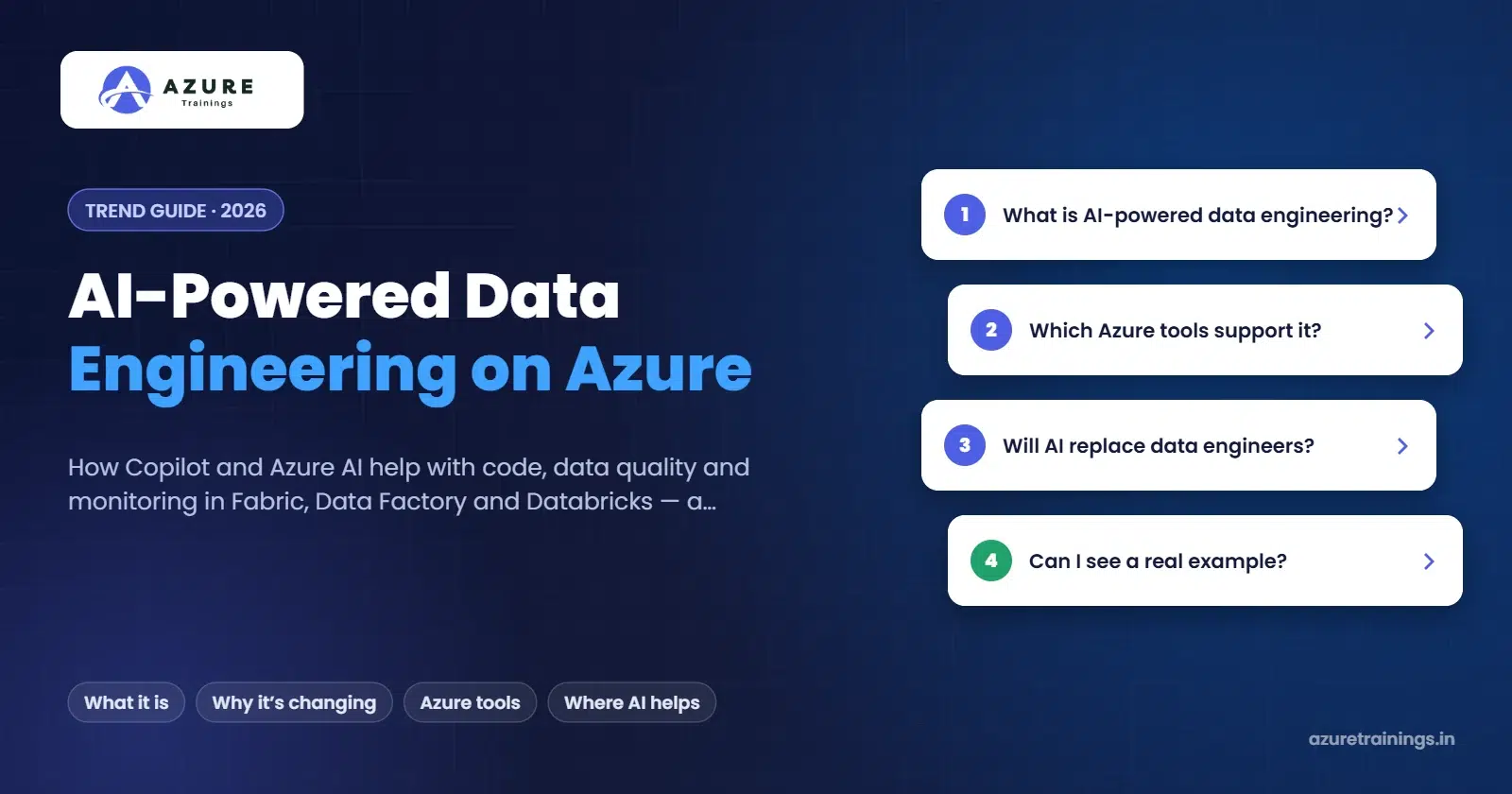
AI-powered data engineering means using generative AI and machine learning to assist pipeline development, data quality checks and monitoring — not to replace engineers. On Azure this centres on Microsoft Fabric, Azure Data Factory, Azure Databricks and Azure AI services. Professionals combine SQL, Python and Spark fundamentals with AI assistance, which is why Azure Data Engineer Training in Hyderabad now covers both layers.

★★★★★

4.9/5 rated by 1329+ students · Google Verified

Table of Contents

Introduction

Azure Data Engineer Syllabus in Hyderabad

Data engineering has changed more in three years than in the decade before it. The job used to mean moving data reliably into a warehouse and keeping the schedules green. That is still the foundation — but no longer the whole job.

Engineers now face different questions. Can this pipeline feed a machine learning model? Can the platform serve a Copilot or an AI agent with governed data? Can quality issues be caught before a business user finds them in a dashboard?

Organisations combine AI with data engineering for a practical reason: AI systems are only as good as the data beneath them. A language model connected to messy, stale data produces confident nonsense. Value has shifted downward in the stack — towards the people who build pipelines, model data and enforce quality.

Azure sits at the centre of this shift. Microsoft has consolidated its data platform around Microsoft Fabric while still supporting Azure Data Factory, Azure Databricks, Azure Synapse Analytics and ADLS Gen2. At Build 2026, Fabric was positioned as the backbone for Microsoft’s Copilot and agent ecosystem, with Fabric data agents now generally available.

There is a local dimension too. In August 2026, Microsoft launched its India South Central cloud region in Hyderabad with three availability zones, serving customers including HDFC Bank, Bajaj Finserv, Air India, Apollo Hospitals and Meesho. For engineers here, that means more Azure workloads running locally and more demand for people who can build on the platform — which is why many professionals choose structured Azure Data Engineer Training in Hyderabad.

What Is AI-Powered Data Engineering on Azure?

AI-powered data engineering is the practice of building and operating data pipelines where AI assists the engineer — in code generation, quality detection, monitoring and optimisation — while the engineer retains responsibility for design, correctness and governance.

Traditional data engineering: the engineer designs a model, writes ingestion and transformation logic, configures orchestration, and maintains it. Quality is enforced through hand-written rules — null checks, row-count reconciliation, referential integrity — and monitoring is threshold-based. This works, but depends on anticipating every failure mode in advance.

AI-assisted data engineering: the engineer still owns the design, but mechanical work changes. Boilerplate code is drafted by Copilot and reviewed. Complex SQL is generated from a description, then tested against real data. Quality anomalies surface statistically. Failures arrive with diagnostic summaries instead of raw stack traces.

Two meanings of “AI in pipelines” are worth separating:

  1. AI assisting pipeline construction — Copilot in Fabric notebooks, AI-assisted authoring in Data Factory, natural-language-to-SQL. Developer productivity.
  2. AI running inside the pipeline — calling a model to classify tickets, extract entities, generate embeddings or score fraud risk. AI as a workload.

A modern Azure Data Engineer needs both. The first changes how you work; the second changes what you build.

Automated data quality uses statistical profiling to catch schema drift, cardinality shifts and freshness gaps that rules miss. Intelligent monitoring correlates failures across a pipeline graph to identify a probable root cause instead of firing twenty alerts for one upstream problem. Predictive analytics is the payoff once data is clean, modelled and timely.

Why AI Is Changing Data Engineering

Where AI genuinely helps a working engineer today:

  • Code generation — drafting PySpark transformations, Delta merge statements, parameterised pipelines.
  • SQL development — converting business logic into joins, CTEs and window functions.
  • Pipeline development — Fabric Data Factory is now agent-ready, exposing authoring and diagnostic capabilities so AI assistants can help build and troubleshoot pipelines and connections.
  • Data quality monitoring — anomaly detection catching drift nobody wrote a rule for.
  • Error detection — explaining a Spark stage failure or skewed join in plain language.
  • Documentation — data dictionaries and lineage notes generated from existing code.
  • Data transformation — suggesting mapping logic between mismatched schemas.
  • Performance optimisation — flagging missing partitioning, inefficient shuffles, poor join strategies.
  • Predictive insights — making forecasting accessible without a dedicated data science team.

The honest limitation

AI does not remove the need for engineering fundamentals. It makes them more important, for one reason: AI generates plausible code very quickly, and plausible is not correct.

An engineer who does not understand window functions cannot tell whether a generated query produces a running total or a partitioned rank. One who does not understand Spark partitioning cannot tell whether that code runs in three minutes or three hours at production volume. One who does not understand slowly changing dimensions cannot tell whether a generated merge silently corrupts history.

AI compresses the time to produce code, not the time to develop judgement — and judgement is what employers hire for. That is why a serious Azure Data Engineer Course in Hyderabad still spends most of its time on SQL, Python, Spark and data modelling rather than prompt tricks.

Why Azure Is Important for AI-Powered Data Engineering

Azure’s advantage is not any single service — it is that the services operate as one estate.

  • Azure Data Factory — orchestration and data movement across on-premises, SaaS, API and cloud sources.
  • Azure Data Lake Storage Gen2 — the scalable storage foundation and landing zone for raw data.
  • Azure Databricks — the heavy processing engine built on Apache Spark, for large-scale transformation and ML.
  • Azure Synapse Analytics — enterprise warehousing through dedicated SQL pools, serverless SQL and Spark pools.
  • Microsoft Fabric — the unified SaaS platform bringing engineering, warehousing, real-time intelligence, data science and Power BI onto one OneLake foundation.
  • Power BI — the consumption layer, now natively part of Fabric.
  • Azure AI services and Azure Machine Learning — prebuilt AI capabilities plus custom model training and deployment.

The architecture matters more than the feature lists: data lands in ADLS Gen2 or OneLake, is orchestrated by Data Factory, processed by Spark, served through a warehouse or lakehouse, visualised in Power BI, and enriched by AI services wherever it makes sense.

Azure Data Factory and AI-Powered Data Pipelines

Most data engineers start here, because orchestration is the connective tissue of every data platform.

  • Pipeline orchestration — activities, dependencies, conditions and retries so multi-step workflows run unattended.
  • Data movement — copy activities, connectors and integration runtimes that reach on-premises sources securely.
  • ETL and ELT — ETL transforms before loading; ELT loads raw then transforms in the destination. Cloud architectures lean ELT, but a competent engineer knows when each applies.
  • Automated workflows — schedule, tumbling window and event-based triggers.
  • Integration with AI and analytics — activities calling Databricks notebooks, Synapse Spark jobs, Azure ML pipelines or Functions, so one orchestration can invoke model training or scoring.
  • Monitoring and scheduling — run history, activity-level diagnostics, alerting and reruns. Microsoft’s official Azure Data Factory documentation is the authoritative reference for connectors and integration runtimes.

Data Factory is where the agent shift is most visible, with AI-assisted authoring extending to code-first Airflow DAGs alongside low-code pipelines. Practical Azure Data Factory training should teach both manual construction and AI-assisted authoring — interviews test the former, daily work increasingly involves the latter.

Core Skills Required for Azure Data Engineers

When people search for Azure Data Engineer Skills or Azure Data Engineer Skills Required, these are the categories that consistently come up.

Technical Skills:

  • SQL — for querying, transforming, and validating relational data
  • Python — for scripting, automation, and PySpark development
  • Apache Spark — for distributed data processing at scale
  • Azure Data Factory — for orchestrating data pipelines
  • Azure Databricks — for big data processing and machine learning prep
  • Azure Synapse Analytics — for enterprise data warehousing
  • Azure Data Lake Storage Gen2 — for scalable data storage
  • Delta Lake — for ACID-compliant data lake transactions
  • Microsoft Fabric — the newer unified analytics platform gaining rapid adoption
  • Power BI — for understanding downstream reporting needs

Conceptual Skills:

  • Data Modeling (star schema, snowflake schema)
  • Data Warehousing principles
  • ETL & ELT design patterns
  • Data Integration across hybrid environments
  • Understanding of data governance and compliance (GDPR, HIPAA, etc.)

Soft Skills:

  • Problem-solving under pressure (pipelines fail — often at the worst times)
  • Clear documentation and communication
  • Collaboration with cross-functional teams
  • Attention to detail when validating large datasets

Azure Data Engineer Tools Used in Real-Time Projects

Here’s how the major tools fit into a real project workflow.

Azure Data Factory (ADF): The orchestration backbone. ADF schedules and automates the movement of data between systems, connecting to over 90 data sources. (See Microsoft’s official Azure Data Factory documentation for the full service overview.) Our Azure Data Factory Training covers this tool through hands-on pipeline-building labs, and you can also prep with our Azure Data Factory Interview Questions.

Azure Databricks: Built on Apache Spark, Databricks is where heavy transformation happens. Engineers write PySpark or SQL notebooks to clean, join, and reshape large datasets.

Azure Synapse Analytics: This is where structured, transformed data lands for enterprise-scale querying and reporting. It combines big data and data warehousing in one platform.

Azure Data Lake Storage Gen2: The storage layer for raw and processed data, supporting both structured and unstructured formats at massive scale. Practice with our Azure Data Lake Interview Questions to see how this comes up in real interviews.

Microsoft Fabric: An increasingly popular unified SaaS platform that combines Data Factory, Synapse, and Power BI capabilities into a single environment — a major reason Microsoft Fabric skills are now in high demand alongside traditional Azure skills. Explore Microsoft’s official Fabric documentation for the platform’s full capabilities.

Delta Lake: Adds reliability to data lakes with ACID transactions, schema enforcement, and time travel (the ability to query historical versions of data).

Power BI: While not built by the data engineer, Power BI depends entirely on clean, well-modeled data — which is why engineers need to understand its data requirements.

Azure Data Engineer Roles Across Different Industries

Every industry uses Azure data engineering slightly differently, but the core responsibilities stay consistent — build reliable pipelines, ensure clean data, and support analytics.

Azure Data Engineer Roles in Banking, Healthcare, Retail, Manufacturing and IT

Banking & Finance: Fraud detection pipelines, real-time transaction monitoring, regulatory reporting, and risk analytics. Data security and compliance are top priorities here.

Healthcare: Managing patient records, integrating data from multiple hospital systems, and ensuring HIPAA-compliant storage and access.

Retail & E-commerce: Customer behavior analytics, inventory forecasting pipelines, and personalized recommendation data feeds.

Manufacturing: IoT sensor data pipelines for predictive maintenance, supply chain analytics, and production efficiency dashboards.

IT & Software: Building internal analytics platforms, customer usage tracking, and product telemetry pipelines for SaaS companies.

Hyderabad, being a major IT and GCC (Global Capability Center) hub, sees strong hiring demand across all these sectors — from banking giants to healthcare tech firms setting up their data engineering teams locally.

Azure Data Engineer Career Path

The career path for an Azure Data Engineer is one of the most structured and rewarding in the tech industry:

  1. Fresher / Trainee — Learning SQL, Python, and basic Azure services
  2. Junior Data Engineer — Building simple pipelines under supervision
  3. Azure Data Engineer — Independently designing and managing pipelines
  4. Senior Azure Data Engineer — Leading pipeline architecture decisions
  5. Lead Data Engineer — Managing a team of engineers and setting best practices
  6. Data Architect — Designing enterprise-wide data strategy and infrastructure

This progression typically takes 6-10 years, though it can move faster with strong certifications, real-world project experience, and continuous upskilling.

Azure Data Engineer Salary in Hyderabad

Hyderabad has become one of India’s leading hubs for cloud and data engineering roles, thanks to its dense concentration of IT parks, GCCs, and product companies. While exact figures vary by company and experience, here’s a general market range:

Experience Level

Approximate Annual Salary (INR)

Fresher (0-1 years)

₹4 – ₹6 LPA

Junior (1-3 years)

₹6 – ₹10 LPA

Mid-level (3-6 years)

₹10 – ₹18 LPA

Senior (6-10 years)

₹18 – ₹30 LPA

Lead / Architect (10+ years)

₹30 LPA+

Salaries tend to rise faster for professionals who combine Azure skills with certifications and hands-on project portfolios — which is precisely the gap that structured Azure Data Engineer Training in Hyderabad is designed to close. For a broader breakdown across Azure roles, see our detailed Azure Salaries in Hyderabad guide.

Azure Data Engineer Certifications

Microsoft’s certification path for data engineers has shifted. The older DP-203: Data Engineering on Microsoft Azure exam was retired on March 31, 2025, and is no longer available to schedule. It has been replaced by:

  • Microsoft Certified: Fabric Data Engineer Associate (DP-700) — the current, primary certification for data engineering on Microsoft’s platform, focused on Microsoft Fabric, OneLake, Spark notebooks, and pipeline implementation. Our Azure Data Engineer Training in Hyderabad program includes structured, exam-focused certification guidance
  • Microsoft Certified: Azure Fundamentals (AZ-900) — a good starting point for beginners, still active and commonly recommended before DP-700
  • Microsoft Certified: Fabric Analytics Engineer Associate (DP-600) — focused on data modeling and analytics within Fabric, complementary to DP-700
  • Databricks Certified Data Engineer Associate — useful for deeper Spark and Databricks expertise

If you see older content (including bootcamps or blog posts) still referencing DP-203 as an active exam, treat it as outdated — Microsoft now points all new candidates toward DP-700. Certifications don’t guarantee a job on their own, but paired with real project experience, they significantly strengthen a resume and demonstrate verified, current skills to employers.

Azure Data Engineer Projects You Will Work On

Real-world projects you can expect to build (and that good training programs simulate) include:

  • Building an end-to-end ETL pipeline from an on-premise SQL database to Azure Data Lake
  • Creating a real-time streaming pipeline using Event Hubs and Databricks
  • Designing a star-schema data warehouse in Azure Synapse Analytics
  • Building a Power BI dashboard powered by a Synapse data model
  • Implementing Delta Lake for slowly changing dimensions
  • Automating pipeline monitoring and failure alerts
  • Migrating a legacy on-premise data warehouse to Microsoft Fabric

Azure Data Engineer Interview Responsibilities

During interviews, candidates are typically assessed on their understanding of real responsibilities, not just theory. Common interview focus areas include:

  • Explaining the difference between ETL and ELT with real examples
  • Writing SQL queries involving joins, window functions, and aggregations
  • Designing a data pipeline architecture for a given business scenario
  • Debugging a failed Azure Data Factory pipeline
  • Explaining partitioning and optimization strategies in Databricks
  • Discussing data security and access control implementation
  • Walking through a past project end-to-end

Interviewers want to see that you understand why you’re using a tool, not just how to click through it. For a deeper practice set, see our full library of Azure Interview Questions.

Azure Data Engineer vs Data Analyst Responsibilities

These roles are often confused, but they serve very different purposes.

A Data Analyst works with already-clean data to generate insights, build reports, and answer business questions. An Azure Data Engineer builds and maintains the systems that make that clean data available in the first place.

Put simply: the Data Engineer builds the pipeline; the Data Analyst drives on the road it creates.

Azure Data Engineer vs Data Scientist Responsibilities

A Data Scientist builds predictive models and runs statistical analysis, often requiring large volumes of clean, well-structured data. An Azure Data Engineer ensures that data is available, reliable, and properly formatted for the data scientist to use.

Without strong data engineering, data science teams spend most of their time cleaning data instead of building models — which is exactly why this role has become so critical to modern data teams.

Common Challenges Faced by Azure Data Engineers

  • Handling pipeline failures during peak business hours
  • Managing schema changes from upstream source systems
  • Balancing cost optimization with performance (cloud costs add up fast)
  • Ensuring data security across hybrid and multi-cloud environments
  • Keeping up with fast-evolving tools like Microsoft Fabric
  • Debugging distributed Spark jobs that fail intermittently

Future Scope of Azure Data Engineering

The demand for Azure Data Engineers is expected to keep growing as:

  • More enterprises adopt Microsoft Fabric as a unified analytics platform
  • AI and machine learning initiatives require larger volumes of clean data
  • Real-time analytics becomes a business necessity rather than a luxury
  • Data governance and compliance requirements continue expanding globally

Cloud data engineering isn’t a passing trend — it’s becoming foundational infrastructure for every data-driven business, making this one of the more future-proof careers in tech today.

Top Responsibilities Employers Expect from Azure Data Engineers

  • Building pipelines that are reliable, not just functional
  • Writing clean, reusable, well-documented code
  • Proactively monitoring and fixing issues before they escalate
  • Understanding the business context behind the data
  • Communicating clearly with non-technical stakeholders

Real-Time Roles in Enterprise Azure Projects

In large enterprise environments, Azure Data Engineers often work within specialized sub-roles:

  • Pipeline Engineer — focuses on ADF orchestration and scheduling
  • Big Data Engineer — focuses on Databricks and Spark optimization
  • Data Warehouse Engineer — focuses on Synapse modeling and performance
  • Data Governance Engineer — focuses on security, lineage, and compliance

Smaller companies often expect one engineer to wear all these hats, while larger enterprises split these into dedicated positions.

Azure Data Engineer Responsibilities for Freshers

  • Learning and applying SQL and Python fundamentals
  • Building simple ADF pipelines under mentorship
  • Understanding basic data modeling concepts
  • Practicing with sample datasets in a sandbox environment
  • Gradually taking ownership of small pipeline components

Azure Data Engineer Responsibilities for Experienced Professionals

  • Architecting scalable, enterprise-grade data pipelines
  • Mentoring junior engineers
  • Making tool and platform decisions (e.g., Synapse vs Fabric)
  • Owning end-to-end data governance strategy
  • Leading migration projects from legacy systems to Azure

Why Choose Azure Data Engineer Training in Hyderabad?

Hyderabad has emerged as one of India’s strongest tech ecosystems, home to major IT companies, global capability centers, and a thriving startup scene. This makes it an ideal location to build a data engineering career — both for learning and for job opportunities.

A well-structured Azure Data Engineer Training in Hyderabad program should offer:

  • Hands-on labs using real Azure environments, not just slides
  • Live projects simulating enterprise scenarios (ETL pipelines, dashboards, data lakes)
  • Coverage of Azure Data Factory, Databricks, Synapse, and Microsoft Fabric
  • Guidance toward DP-700 (Fabric Data Engineer Associate) certification
  • Resume building and mock interview support
  • Access to trainers with real industry project experience

Check our detailed Azure Course Syllabus to see exactly what’s covered, module by module.

The goal isn’t just to learn tool names — it’s to walk away able to build, debug, and optimize real data pipelines, which is what employers are actually hiring for.

Career Opportunities After Azure Data Engineer Training in Hyderabad

After completing training, common job titles you can target include:

  • Azure Data Engineer
  • Big Data Engineer
  • ETL Developer
  • Cloud Data Engineer
  • Data Pipeline Engineer
  • BI Data Engineer
  • Data Warehouse Developer

These roles are actively hired across Hyderabad’s IT corridors, particularly in HITEC City and Gachibowli, where many global companies run their data and analytics teams. See our full breakdown of Azure Job Roles in Hyderabad, and check our 100% Placement Assistance program for how we help you land one of these roles.

Roles & Responsibilities

Responsibility

Azure Tool Used

Business Purpose

Required Skill

Data ingestion from multiple sources

Azure Data Factory

Centralize data for analysis

Pipeline orchestration, connectors

Big data transformation

Azure Databricks

Clean and reshape large datasets

PySpark, Python, Spark SQL

Enterprise data warehousing

Azure Synapse Analytics

Enable fast, large-scale querying

Data modeling, SQL

Raw & processed data storage

Azure Data Lake Storage Gen2

Scalable, cost-effective storage

Storage architecture

Reliable, versioned data lake transactions

Delta Lake

Ensure data accuracy and rollback ability

ACID transaction concepts

Unified analytics platform management

Microsoft Fabric

Simplify multi-tool workflows

Fabric administration

Reporting data preparation

Power BI (data modeling)

Support business dashboards

Data modeling, DAX basics

Data validation and quality checks

SQL, Python

Prevent bad data from reaching reports

Query writing, scripting

Data security & governance

Azure security tools, RBAC

Meet compliance requirements

Access control, governance policy

Career Growth

Experience

Role

Responsibilities

Expected Skills

0-1 years

Fresher

Learning tools, assisting with basic tasks

SQL, Python basics, Azure fundamentals

1-2 years

Junior Data Engineer

Building simple pipelines under guidance

ADF basics, SQL, beginner PySpark

2-5 years

Azure Data Engineer

Independently designing and managing pipelines

ADF, Databricks, Synapse, Delta Lake

5-8 years

Senior Azure Data Engineer

Leading pipeline architecture and optimization

Advanced Spark, performance tuning, mentoring

8-12 years

Lead Data Engineer

Managing engineering teams, setting standards

Team leadership, architecture design

12+ years

Data Architect

Designing enterprise-wide data strategy

Enterprise architecture, governance, strategy

Comparison

Role

Responsibilities

Skills

Salary (India, approx.)

Career Growth

Azure Data Engineer

Builds and maintains data pipelines and storage

SQL, Python, Spark, ADF, Databricks, Synapse

₹6 – ₹30+ LPA

Data Architect, Lead Engineer

Data Analyst

Analyzes clean data, builds reports and dashboards

SQL, Excel, Power BI, basic statistics

₹4 – ₹15 LPA

Senior Analyst, BI Manager

Data Scientist

Builds predictive models and statistical analysis

Python, ML, statistics, SQL

₹6 – ₹25+ LPA

Senior Data Scientist, ML Lead

Cloud Engineer

Manages cloud infrastructure and deployment

Azure/AWS, networking, DevOps, IaC

₹6 – ₹22+ LPA

Cloud Architect, DevOps Lead

Key Takeaways

  1. Azure Data Engineers design, build, and maintain the data pipelines that power modern analytics and business intelligence.
  2. Core responsibilities span data ingestion, transformation, storage, security, and cross-team collaboration.
  3. Key tools include Azure Data Factory, Databricks, Synapse Analytics, Data Lake Storage, and increasingly, Microsoft Fabric.
  4. Hyderabad offers strong career opportunities, competitive salaries, and a growing demand for certified Azure Data Engineers.
  5. Structured Azure Data Engineer Training in Hyderabad, combined with certifications like DP-700, significantly improves job readiness and career growth.

Conclusion

Azure Data Engineering isn’t just a job title — it’s the backbone of every data-driven decision a modern business makes. From building pipelines in Azure Data Factory to optimizing Spark jobs in Databricks and designing warehouses in Synapse Analytics, this role sits at the center of enterprise data strategy.

If you’re ready to move beyond theory and build the hands-on skills employers are actively hiring for, now is the time to act. Enroll in Azure Data Engineer Training in Hyderabad today, work on real-time projects, and prepare confidently for your Azure certification and your next career move.

Frequently Asked Questions

1. What does an Azure Data Engineer do on a daily basis?

They build and monitor data pipelines, write SQL/PySpark code for data transformation, troubleshoot failures, and collaborate with analysts and data scientists on data requirements.

2. Is Azure Data Engineer a good career in 2026?

Yes. With growing cloud adoption and Microsoft Fabric expansion, demand for skilled Azure Data Engineers continues to rise across nearly every industry.

3. What skills are required to become an Azure Data Engineer?

Core skills include SQL, Python, Apache Spark, Azure Data Factory, Databricks, Synapse Analytics, and an understanding of data modeling and ETL/ELT concepts.

4. What is the salary of an Azure Data Engineer in Hyderabad?

Salaries typically range from ₹4-6 LPA for freshers to ₹30+ LPA for senior architects, depending on experience and certifications.

5. Which certification is best for Azure Data Engineers?

The Microsoft Certified: Azure Data Engineer Associate (DP-203) is the most recognized and industry-relevant certification for this role.

6. What is the difference between Azure Data Engineer and Data Analyst?

A Data Engineer builds and maintains the data pipelines and infrastructure, while a Data Analyst uses that clean data to generate business insights and reports.

7. Do Azure Data Engineers need to know Python?

Yes, Python (especially PySpark) is essential for writing transformation logic in Azure Databricks and automating data workflows.

8. What tools should I learn for Azure Data Engineering?

Focus on Azure Data Factory, Azure Databricks, Azure Synapse Analytics, Azure Data Lake Storage Gen2, Delta Lake, and increasingly, Microsoft Fabric.

9. Can a fresher become an Azure Data Engineer?

Yes, with structured training covering SQL, Python, and Azure tools, freshers can start as Junior Data Engineers and grow into full Azure Data Engineer roles.

10. How long does it take to become job-ready as an Azure Data Engineer?

With focused, hands-on training, most learners become job-ready in 3-6 months, depending on prior technical background and practice consistency.

Take your Next Step in Your Data Engineer Journey!

Fill out the form below and our course advisor will contact you shortly.