
Azure Data Engineer Job Roles
Azure Data Engineer job roles in Hyderabad span entry-level, mid-level, senior, lead, and architect positions. These professionals build and manage data pipelines using Azure Data Factory, Databricks, Synapse, and Microsoft Fabric. Hyderabad’s strong cloud hiring market, competitive salaries, and demand from product and IT services companies make it one of India’s best cities for an Azure data engineering career.
★★★★★
4.9/5 rated by 1329+ students · Google Verified
Table of Contents
Introduction
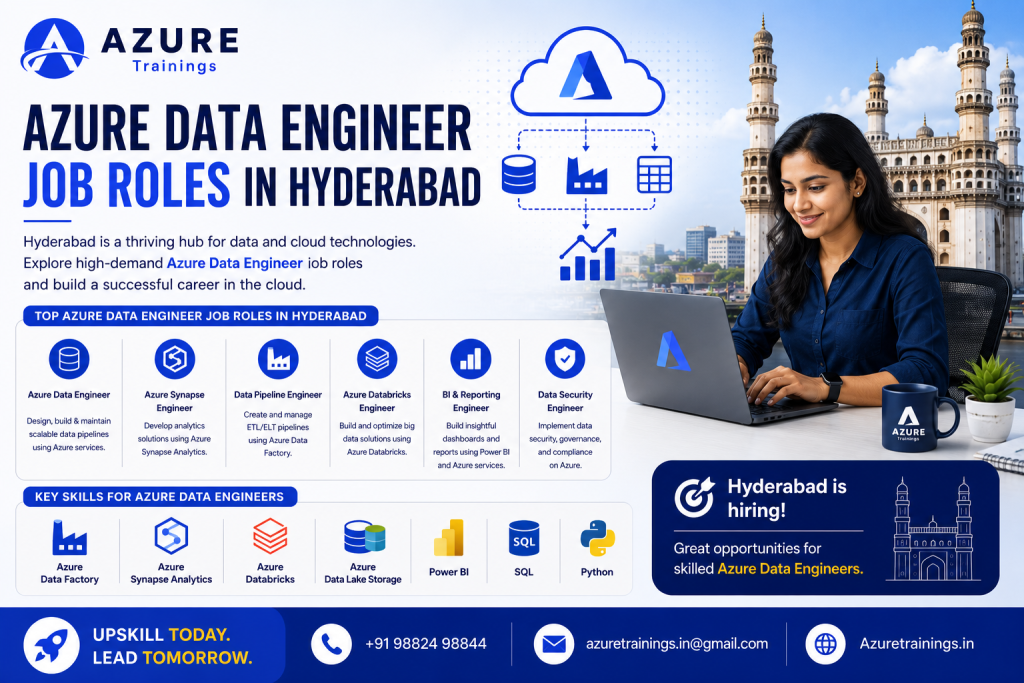
If you have been searching for Azure Data Engineer job roles in Hyderabad, you are looking at one of the most in-demand and well-paid technology careers in the city right now. Hyderabad has quietly become a serious cloud and data hub — Microsoft has a large campus here, and global capability centres (GCCs), product companies, and IT services firms are all hiring data engineers who can work confidently on the Azure platform.
An Azure Data Engineer is the person who makes data usable. They design the pipelines that move raw information from dozens of sources into clean, reliable, query-ready stores so that analysts, data scientists, and business teams can actually trust the numbers they report. It is part plumbing, part architecture, and part problem-solving — and it pays well because getting it wrong is expensive.
The reason this career is in such high demand is simple: almost every company is now sitting on more data than it can handle, and cloud platforms like Microsoft Azure have become the default home for that data. As organisations migrate off ageing on-premise systems, they need people who understand both data engineering fundamentals and the specific Azure tools that power modern data platforms.
Cloud and data engineering roles in Hyderabad have grown steadily over the last few years, and the variety of Azure Data Engineer job roles in Hyderabad means there is a genuine path for everyone — whether you are a fresher writing your first SQL query or an experienced engineer eyeing an architect title. This guide walks through every major role, what each one actually does day to day, the skills and certifications that move you up the ladder, realistic salary expectations, and which companies are hiring.
What is an Azure Data Engineer?
An Azure Data Engineer designs, builds, and maintains data systems on Microsoft Azure. Their core job is to collect data from multiple sources, transform it into a clean and structured format, and store it so downstream teams can analyse it.
In plain terms, they:
- Build data pipelines that move and process data automatically.
- Run ETL and ELT (Extract, Transform, Load / Extract, Load, Transform) processes.
- Design data warehouses and data lakes that store large volumes of structured and unstructured data.
- Handle data modeling so information is organised logically and performs well in queries.
- Manage cloud data integration across different systems and applications.
They spend most of their time inside tools like Azure Data Factory (for orchestrating pipelines), Azure Databricks and Apache Spark (for large-scale processing), Azure Synapse Analytics (for warehousing and analytics), Azure Data Lake Storage Gen2 (for scalable storage), and increasingly Microsoft Fabric, Microsoft’s unified analytics platform. They write a lot of SQL and Python, work with Delta Lake for reliable big-data storage, and often prepare datasets that feed into Power BI dashboards.
If a data scientist is the chef and the analyst is the waiter, the data engineer built the kitchen.
Why Azure Data Engineer Job Roles Are in Demand in Hyderabad
Hyderabad is no longer just a back-office IT city — it has become a product and engineering destination. A few specific factors are driving demand for Azure Data Engineer jobs in Hyderabad:
- Microsoft’s strong local presence. Microsoft’s India Development Center is based in Hyderabad, and a healthy ecosystem of Azure-focused partners and customers has grown around it.
- The GCC boom. Global capability centres for banking, retail, healthcare, and manufacturing companies have set up large data and analytics teams in Hyderabad, and most are standardising on Azure.
- Cloud migration projects. IT services giants headquartered or heavily staffed in Hyderabad are running long-running cloud migration and modernisation projects, all of which need data engineers.
- The shift to Microsoft Fabric. As companies adopt Fabric, there is fresh demand for engineers who understand the newest platform rather than only legacy tooling.
The result is a deep, varied job market. You will see openings ranging from fresher-friendly junior roles to highly paid architect positions, often within the same company.
Azure Data Engineer Job Roles in Hyderabad
Before going role by role, here is the big picture. Azure Data Engineer job roles in Hyderabad generally fall into five tiers, and the title you hold depends mostly on experience, scope of ownership, and how much architecture versus hands-on building you do.
Job Role | Experience Required | Key Responsibilities | Skills Needed | Career Growth |
Junior Azure Data Engineer | 0–2 years | Build and monitor basic pipelines, write SQL queries, assist with data ingestion and testing | SQL, Python basics, Azure Data Factory, ADLS Gen2 fundamentals | Promotion to Azure Data Engineer in 1–2 years |
Azure Data Engineer | 2–5 years | Design ETL/ELT pipelines, manage data lakes, build data models, optimise queries | ADF, Databricks, Synapse, Spark, advanced SQL, Python | Path to Senior Data Engineer |
Senior Azure Data Engineer | 5–8 years | Own complex pipelines, set standards, mentor juniors, optimise cost and performance | Spark optimisation, Delta Lake, data architecture basics, CI/CD | Path to Lead or Architect |
Lead Data Engineer | 8–12 years | Lead a data engineering team, define technical direction, manage delivery | Team leadership, platform design, governance, stakeholder management | Path to Architect or Engineering Manager |
Azure Data Architect | 10+ years | Design end-to-end data platforms, set strategy, choose tools, ensure scalability and security | Solution architecture, Azure ecosystem, security, governance, cost design | Path to Principal Architect / Head of Data |
Data Platform Engineer | 4–8 years | Build and maintain the underlying data platform, infrastructure-as-code, reliability | DevOps, Terraform/Bicep, Azure infra, monitoring, Spark | Senior Platform / Reliability roles |
Cloud Data Engineer | 3–7 years | Integrate data across cloud services, manage cloud-native pipelines and storage | Multi-service Azure, networking basics, integration patterns, SQL/Python | Senior Cloud / Architect roles |
Microsoft Fabric Engineer | 2–6 years | Build analytics solutions on Microsoft Fabric, OneLake, and Power BI integration | Microsoft Fabric, Spark, SQL, Power BI, Delta Lake | Fabric specialist / Analytics Architect |
Salary note: Salary expectations for these roles are covered in detail in the dedicated salary section below, with sourcing.
Entry-Level Azure Data Engineer Roles
Entry-level roles are where most people start, and Hyderabad has a healthy supply of them thanks to the sheer number of teams scaling up.
Typical entry-level titles include Junior Azure Data Engineer, Associate Data Engineer, and Data Engineer Trainee. At this stage you are expected to:
- Write and debug SQL queries.
- Build simple ingestion pipelines in Azure Data Factory.
- Load data into Azure Data Lake Storage Gen2.
- Help test and monitor existing pipelines.
- Learn the team’s data models and conventions.
Employers usually expect strong fundamentals rather than deep experience — clear SQL, some Python, and a working understanding of how data moves through a pipeline. A relevant certification like DP-900 or DP-700 helps your resume stand out for these roles.
Mid-Level Azure Data Engineer Roles
The mid-level Azure Data Engineer role (roughly 2–5 years of experience) is the backbone of most data teams. This is where you go from following instructions to owning pieces of the platform.
At this level you typically:
- Design and build ETL/ELT pipelines end to end.
- Work hands-on with Azure Databricks and Apache Spark for large-scale transformation.
- Build and maintain data warehouses in Azure Synapse Analytics.
- Use Delta Lake for reliable, versioned big-data storage.
- Handle data modeling and performance tuning.
- Prepare curated datasets for Power BI reporting.
Mid-level engineers are expected to make good technical decisions independently and to understand the trade-offs between cost, speed, and reliability.
Senior Azure Data Engineer Roles
A Senior Azure Data Engineer (around 5–8 years) owns the harder problems. They are the people a team turns to when a pipeline keeps failing at scale or when costs are spiralling.
Responsibilities usually include:
- Owning the most complex and business-critical pipelines.
- Optimising Spark jobs and Synapse queries for performance and cost.
- Setting coding standards and reviewing other engineers’ work.
- Designing parts of the data architecture.
- Mentoring junior and mid-level engineers.
- Introducing CI/CD and automated testing for data pipelines.
This is the natural launchpad toward Lead and Architect positions.
Azure Data Architect Roles
The Azure Data Architect sits at the top of the individual-contributor track. Rather than building pipelines all day, they design the whole platform and make the big decisions.
A data architect typically:
- Designs end-to-end data platforms on Azure.
- Chooses the right combination of tools — Fabric, Synapse, Databricks, Data Factory, and storage.
- Defines data governance, security, and access controls.
- Plans for scalability, reliability, and cost efficiency.
- Sets the technical strategy that engineering teams then execute.
Architect roles in Hyderabad are well paid and competitive, and they usually require 10+ years of experience plus a strong track record of delivery.
Azure Data Engineering Team Structure
Understanding the team structure helps you see where each role fits and where you can grow. A typical Azure data engineering team in a Hyderabad company looks like this:
- Azure Data Architect — sets platform strategy and design.
- Lead Data Engineer — translates strategy into delivery, manages the team.
- Senior Azure Data Engineers — own complex components and mentor others.
- Azure Data Engineers (mid-level) — build and maintain most pipelines.
- Junior / Associate Data Engineers — handle ingestion, testing, and support tasks.
- Data Platform Engineers — keep the underlying infrastructure healthy.
Larger organisations may also have dedicated Microsoft Fabric Engineers, Cloud Data Engineers, and analytics or BI specialists working alongside this core team.
Roles and Responsibilities of an Azure Data Engineer
Across every level, certain responsibilities show up again and again. An Azure Data Engineer is generally responsible for:
- Designing data pipelines to move data from source systems into storage and analytics layers using Azure Data Factory.
- Building ETL and ELT processes to clean, transform, and enrich raw data.
- Processing large datasets with Azure Databricks and Apache Spark.
- Managing data warehouses in Azure Synapse Analytics.
- Storing data at scale in Azure Data Lake Storage Gen2 and Delta Lake.
- Modeling data so it is organised, consistent, and query-efficient.
- Integrating cloud data across multiple Azure and third-party services.
- Writing SQL and Python for transformation, automation, and analysis.
- Supporting analytics and reporting, often by preparing data for Power BI.
- Adopting Microsoft Fabric for unified analytics where the company has moved to it.
- Monitoring, securing, and optimising pipelines for reliability and cost.
The exact mix shifts with seniority — juniors do more building and monitoring, while seniors and architects do more design and decision-making. For a deeper breakdown of each duty, see our full guide to the roles and responsibilities of an Azure Data Engineer.
Skills Required for Azure Data Engineer Job Roles
To compete for Azure Data Engineer jobs in Hyderabad, you need a blend of core data skills and Azure-specific tooling:
Core technical skills
- Strong SQL for querying and transformation.
- Python for scripting, automation, and Spark work.
- Solid understanding of ETL/ELT, data modeling, and data warehousing concepts.
Azure platform skills
- Azure Data Factory for orchestration.
- Azure Databricks and Apache Spark for big-data processing.
- Azure Synapse Analytics for warehousing.
- Azure Data Lake Storage Gen2 and Delta Lake for storage.
- Microsoft Fabric for unified analytics.
- Power BI familiarity for downstream reporting.
Supporting skills
- Version control (Git) and basic CI/CD.
- Awareness of data governance, security, and cost optimisation.
- Communication skills — engineers who can explain trade-offs get promoted faster.
For the complete, ordered list of what employers expect, see the full guide to Azure Data Engineer skills required in 2026.
Azure Data Engineering Tools Used in Job Roles
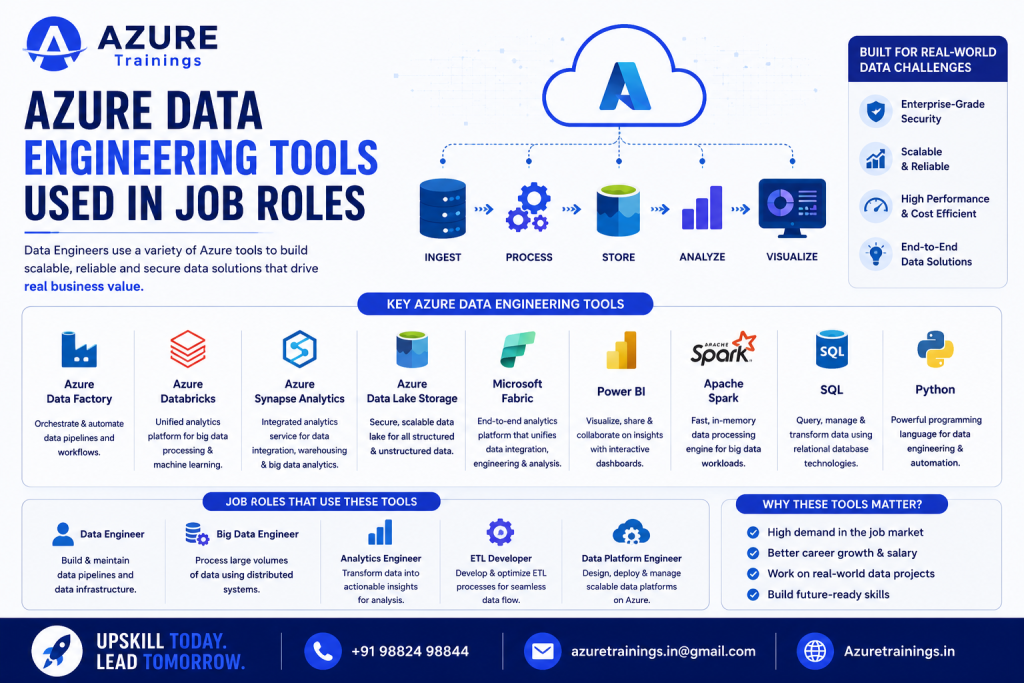
These are the tools you will see named in almost every Hyderabad job description, and what each is used for:
- Azure Data Factory — orchestrating and scheduling data pipelines.
- Azure Databricks — collaborative big-data processing built on Spark.
- Apache Spark — the distributed processing engine behind large-scale transformation.
- Azure Synapse Analytics — enterprise data warehousing and analytics.
- Azure Data Lake Storage Gen2 — scalable, low-cost storage for raw and processed data.
- Delta Lake — adds reliability (ACID transactions) to data lakes.
- Microsoft Fabric — Microsoft’s unified analytics platform with OneLake at its core.
- Power BI — business intelligence and dashboards.
- SQL and Python — the everyday languages of the role.
Azure Data Engineer Career Path in Hyderabad
The career path is refreshingly clear, which is part of why this field appeals to so many people. Here is how progression typically works.
Stage | Job Title | Skills Required | Certifications | Career Outcome |
Beginner | Junior / Associate Azure Data Engineer | SQL, Python basics, ADF, ADLS Gen2 | AZ-900, DP-900 | Build a strong foundation and move into a full Data Engineer role |
Intermediate | Azure Data Engineer | ETL/ELT, Databricks, Synapse, Spark, data modeling | DP-700 | Own pipelines independently; become a trusted team member |
Advanced | Senior Azure Data Engineer / Lead | Spark optimisation, Delta Lake, architecture, mentoring, CI/CD | DP-700, DP-600 (optional) | Lead projects and people; step toward architecture |
Expert | Azure Data Architect / Principal | Solution architecture, governance, security, cost strategy | DP-700, DP-600, advanced Azure architecture certifications | Define platform strategy; lead the data function |
The key takeaway: each stage builds on the last, and certifications align neatly with where you are in the journey.
Azure Data Engineer Salary by Job Role
Salary is one of the biggest reasons people pursue this career, so it is worth being precise — and honest — about the numbers.
The verified benchmark for a core Azure Data Engineer role in Hyderabad is an average of approximately ₹9.05 LPA, with a typical range of roughly ₹5.85 LPA to ₹15.75 LPA (source: Glassdoor, Hyderabad, March 2026). Actual pay varies significantly with your specific skills, the type of company (product firms and GCCs often pay more than services firms), and your negotiation. For a fuller picture across experience levels, see our detailed Azure Data Engineer salary breakdown.
The figures below for other roles are indicative market estimates anchored to that benchmark and to general Hyderabad hiring patterns. They should be treated as directional, not guaranteed, and verified against live listings before you set expectations:
Job Role | Indicative Salary Range (Hyderabad) |
Junior / Associate Azure Data Engineer | ₹4–7 LPA |
Azure Data Engineer (verified benchmark) | ₹5.85–15.75 LPA (avg ~₹9.05 LPA) |
Senior Azure Data Engineer | ₹15–25 LPA |
Lead Data Engineer | ₹22–35 LPA |
Azure Data Architect | ₹28–45 LPA |
Top Companies Hiring Azure Data Engineers in Hyderabad
Hyderabad’s employer base for data engineering is broad. The main categories hiring Azure Data Engineers include:
- Microsoft and its partner ecosystem, given the company’s large Hyderabad presence.
- Global capability centres (GCCs) for banking, insurance, retail, healthcare, and manufacturing firms.
- Major IT services companies running cloud migration and data modernisation programs.
- Product and SaaS companies building data-heavy platforms.
- Consulting and analytics firms delivering Azure projects for clients.
Rather than chasing a fixed “top 10” list — which changes constantly — it is more useful to target these categories on job platforms and filter for Azure-specific skills.
Future Scope of Azure Data Engineering Careers
The outlook is strong. A few trends point to durable demand:
- Microsoft Fabric adoption is creating a wave of new projects and a shortage of engineers who know the platform well.
- AI and analytics workloads depend on well-engineered data — you cannot build reliable AI on messy data, which keeps data engineers central.
- Ongoing cloud migration means years of modernisation work still ahead for many enterprises.
- Data governance and security requirements keep growing, increasing the value of engineers who understand them.
In short, the role is not going away — it is becoming more strategic. To see where this demand is concentrated nationwide, explore Azure Data Engineer career opportunities in India.
Top Azure Data Engineer Job Roles That Employers Are Hiring For
If you scan current Hyderabad listings, these are the titles that appear most often:
- Azure Data Engineer (the core, most-advertised role).
- Senior Azure Data Engineer.
- Microsoft Fabric Engineer (rapidly growing).
- Data Platform Engineer.
- Cloud Data Engineer.
- Lead Data Engineer.
- Azure Data Architect.
The fastest-growing of these is the Microsoft Fabric Engineer, simply because the platform is new and the talent pool is still small.
Azure Data Engineer Job Roles for Freshers
Freshers are far from locked out of this field — you just need to target the right roles and prove your fundamentals.
Good fresher-friendly roles include:
- Junior Azure Data Engineer
- Associate Data Engineer
- Data Engineer Trainee / Intern
- Data Analyst-to-Engineer transition roles
To break in as a fresher, focus on SQL and Python, build two or three end-to-end projects using Azure Data Factory and Databricks, and earn the DP-900 and then DP-700 certifications. A small portfolio of real pipelines beats a long list of buzzwords on a resume.
Azure Data Engineer Job Roles for Experienced Professionals
Experienced professionals — including those moving from SQL development, ETL tools, on-premise data warehousing, or analytics — are in a strong position.
Roles to aim for include:
- Azure Data Engineer (mid-level) if you are 2–5 years in.
- Senior Azure Data Engineer at 5–8 years.
- Lead Data Engineer and Data Platform Engineer with leadership experience.
- Azure Data Architect at 10+ years.
The fastest way to move up is to pair your existing experience with current Azure skills — especially Microsoft Fabric, Databricks/Spark optimisation, and Delta Lake — and to get the DP-700 certification to validate the platform knowledge.
Highest Paying Azure Data Engineering Roles in Hyderabad
Based on the indicative ranges above, the highest-paying roles in Hyderabad are:
- Azure Data Architect — the top of the technical ladder.
- Lead Data Engineer — combines deep skills with team leadership.
- Senior Azure Data Engineer — especially those with strong Spark and Fabric expertise.
- Specialist Microsoft Fabric Engineers — scarcity drives premium pay.
The common thread among the best-paid roles is rare, in-demand skills (Fabric, Spark optimisation, architecture) plus a track record of delivering reliable, cost-efficient platforms. (Salary positioning is directional; see the salary section for sourcing.)
How to Become an Azure Data Engineer in Hyderabad
Here is a realistic, step-by-step path:
- Master the fundamentals. Get genuinely comfortable with SQL and Python.
- Learn data engineering concepts. Understand ETL/ELT, data warehousing, and data modeling.
- Build Azure skills. Work hands-on with Azure Data Factory, Databricks, Synapse, ADLS Gen2, and Microsoft Fabric.
- Earn certifications. Follow the path AZ-900 → DP-900 → DP-700, with DP-600 as an optional advanced step.
- Build real projects. Create end-to-end pipelines you can demonstrate and explain.
- Apply strategically. Target GCCs, product companies, and services firms, and tailor your resume to the tools in each listing.
Structured training can compress this journey significantly. A focused Azure Data Engineer Training in Hyderabad program — such as the one offered by Azure Trainings (a Brolly Academy initiative) — concentrates on the current Azure data engineering stack and the DP-700 path, which matters because much of the older training material still teaches the retired DP-203 syllabus.
Azure Data Engineer Certifications That Improve Job Opportunities
Certifications validate your skills and help your resume pass screening. Here are the ones that matter, in order:
- AZ-900 (Microsoft Azure Fundamentals) — a beginner-friendly entry point that proves basic Azure knowledge.
- DP-900 (Microsoft Azure Data Fundamentals) — introduces core data concepts on Azure.
- DP-700 (Microsoft Certified: Fabric Data Engineer Associate) — the current, role-defining certification for Azure data engineers. This is the one to prioritise.
- DP-600 (Microsoft Certified: Fabric Analytics Engineer Associate) — an optional advanced track for engineers moving toward analytics and Fabric specialisation.
- Microsoft Fabric certifications — increasingly valuable as more companies adopt Fabric.
A note on DP-203 (legacy reference): You will still see DP-203 (the former Azure Data Engineer Associate exam) mentioned in older job posts, course descriptions, and blogs. DP-203 was retired on 31 March 2025 and has been replaced by DP-700. If a training provider is still selling DP-203 as a current certification, treat that as a red flag — it tells you their material is out of date. Aim for DP-700 instead.
Key Takeaways
- Azure Data Engineer job roles in Hyderabad range from fresher-friendly junior positions to highly paid architect roles, with a clear path between them.
- The core skills are SQL and Python plus hands-on Azure tools — Data Factory, Databricks, Synapse, ADLS Gen2, Delta Lake, and Microsoft Fabric.
- The verified average salary for a core role is about ₹9.05 LPA (₹5.85–15.75 LPA range, Glassdoor Hyderabad, March 2026), with senior and architect roles paying more.
- The current certification path is AZ-900 → DP-900 → DP-700; DP-203 was retired in March 2025 and replaced by DP-700.
- Demand is strong and durable, driven by Microsoft Fabric adoption, GCC growth, and ongoing cloud migration.
Conclusion
Azure data engineering is one of the clearest, best-paid, and most future-proof technology careers available in Hyderabad today. The roles are varied, the progression is well-defined, and the demand — fuelled by Microsoft Fabric adoption, the GCC boom, and relentless cloud migration — shows no sign of slowing.
The professionals who win these roles are the ones who pair strong fundamentals with current Azure skills and the right certification. That means mastering SQL and Python, getting genuinely hands-on with the Azure data stack, and earning the DP-700 certification rather than the retired DP-203.
If you are serious about building a cloud data engineering career in Hyderabad, the best time to start was a year ago — the second-best time is now. Build the skills, earn the certifications, ship a few real projects, and you will be well-positioned for the Azure Data Engineer job roles in Hyderabad that employers are actively trying to fill. Structured, up-to-date training can get you there faster — choose an Azure Data Engineer course in Hyderabad that teaches the current DP-700 path, and start building your future as an Azure Data Engineer today.
Frequently Asked Questions
1. What does an Azure Data Engineer do?
An Azure Data Engineer builds and maintains data pipelines on Microsoft Azure, moving data from source systems into clean, structured storage using tools like Azure Data Factory, Databricks, Synapse, and Microsoft Fabric so teams can analyse it reliably.
2. What are the main Azure Data Engineer job roles in Hyderabad?
The main roles are Junior/Associate Data Engineer, Azure Data Engineer, Senior Azure Data Engineer, Lead Data Engineer, Data Platform Engineer, Cloud Data Engineer, Microsoft Fabric Engineer, and Azure Data Architect.
3. Is Hyderabad good for Azure Data Engineer jobs?
Yes. Hyderabad has a strong cloud hiring market driven by Microsoft’s local presence, a large number of global capability centres, and ongoing cloud migration projects, giving roles for both freshers and experienced professionals.
4. What is the salary of an Azure Data Engineer in Hyderabad?
The average salary for a core Azure Data Engineer role in Hyderabad is approximately ₹9.05 LPA, with a typical range of about ₹5.85–15.75 LPA (source: Glassdoor, Hyderabad, March 2026). Senior and architect roles pay considerably more.
5. What skills do I need for Azure Data Engineer jobs?
You need strong SQL and Python, plus hands-on experience with Azure Data Factory, Databricks, Apache Spark, Synapse Analytics, Data Lake Storage Gen2, Delta Lake, and increasingly Microsoft Fabric, along with ETL/ELT and data modeling knowledge.
6. Can a fresher get an Azure Data Engineer job in Hyderabad?
Yes. Freshers can target Junior or Associate Data Engineer and trainee roles by mastering SQL and Python, building a few real Azure projects, and earning the DP-900 and DP-700 certifications.
7. Which certification is best for an Azure Data Engineer?
DP-700 (Microsoft Certified: Fabric Data Engineer Associate) is the current, role-defining certification. The recommended path is AZ-900 → DP-900 → DP-700, with DP-600 as an optional advanced step.
8. Is DP-203 still valid for Azure Data Engineers?
No. DP-203 was retired on 31 March 2025 and has been replaced by DP-700. You should pursue DP-700 instead; DP-203 now exists only as a legacy reference.
9. What is the highest-paying Azure data engineering role in Hyderabad?
The Azure Data Architect role is generally the highest-paying, followed by Lead Data Engineer and senior engineers with rare Microsoft Fabric and Spark optimisation skills.
10. How long does it take to become an Azure Data Engineer?
With focused effort, many people reach a job-ready level in roughly 4–8 months by mastering the fundamentals, learning the Azure stack, earning certifications, and building portfolio projects — though timelines vary by background.
