
🏆 #1 Azure Training Institute in Hyderabad
✅ 100% Placement Assistance
Azure Data Engineer Roadmap in Hyderabad
An Azure Data Engineer builds and manages data pipelines, storage, and analytics solutions on Microsoft Azure. This Azure Data Engineer Roadmap walks you through every stage — cloud fundamentals, SQL, Python, Azure Data Factory, Databricks, Synapse, and Microsoft Fabric — plus the current 2026 certification path (DP-900 → DP-700), India salary trends, and 90-day and 6-month learning plans for freshers and job seekers.
★★★★★
4.9/5 rated by 1329+ students · Google Verified
Table of Contents
Introduction
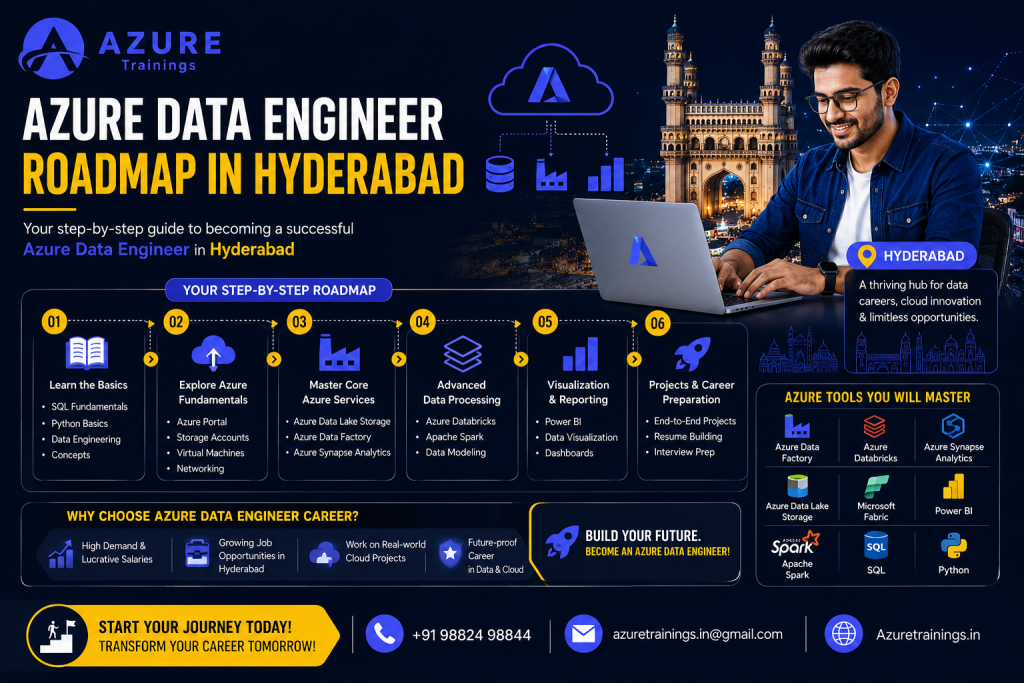
If you have searched for an Azure Data Engineer Roadmap, you are probably staring at a long list of tools — Data Factory, Databricks, Synapse, Spark, Fabric — and wondering where to even begin. That feeling is normal. The role is broad, the tooling changes fast, and a lot of advice online is already out of date.
So let’s make this simple.
An Azure Data Engineer designs the systems that move, clean, store, and serve data so that analysts, data scientists, and business teams can actually use it. In plain terms: data scientists build the models, but data engineers build the plumbing that feeds those models. Without good plumbing, nothing downstream works.
A structured Azure Data Engineer learning path matters because the field rewards depth, not dabbling. Randomly watching tutorials on ten different tools leaves you with shallow knowledge and an unconvincing resume. A roadmap forces the right order: fundamentals first, then SQL and Python, then orchestration and big-data tools, then certifications and projects that prove you can do the job.
The demand side is encouraging, especially in India. Indian enterprises across BFSI, healthcare, e-commerce, consulting, and product companies are migrating data platforms to the cloud and building real-time analytics pipelines, and that migration is fueling steady hiring for cloud data roles. Hyderabad, Bangalore, Pune, Mumbai, and Delhi NCR remain the strongest hiring hubs.
Follow a proper Azure Data Engineer career roadmap and you give yourself the clearest route to a well-paid, future-proof cloud career. This guide lays out that route step by step — including the certification change most older articles still get wrong.
What is an Azure Data Engineer?
An Azure Data Engineer is a cloud data professional who builds and maintains the infrastructure that turns raw data into usable, trustworthy information on Microsoft Azure.
Day to day, the role usually involves:
- Designing data pipelines that ingest data from databases, APIs, files, and streaming sources.
- Building ETL/ELT workflows to clean, transform, and standardize data.
- Managing storage in data lakes and data warehouses.
- Optimizing performance and cost of queries and pipelines.
- Implementing data governance and security — access control, encryption, and monitoring.
- Serving data to analytics and BI tools like Power BI.
The role sits between raw source systems and the people who consume data. If a Power BI dashboard is wrong, slow, or empty, the data engineer is usually the one who diagnoses and fixes it.
This is different from a Data Analyst (who interprets data) and a Data Scientist (who models and predicts from data). The data engineer makes both of those jobs possible.
Why You Need an Azure Data Engineer Roadmap
A good Azure Data Engineering roadmap solves three problems at once.
- It prevents tool overwhelm. Azure has dozens of data services. A roadmap tells you which five or six actually matter for an entry-level role and which can wait.
- It enforces the right learning order. You cannot understand Azure Data Factory pipelines if you do not understand SQL joins or what a data warehouse is. Skipping fundamentals is the single most common reason people stall.
- It keeps you employable, not just educated. A roadmap ties each skill to an outcome — a project, a certification, or a job-ready capability — instead of leaving you with disconnected tutorial knowledge.
Here is why it matters in practice: hiring managers can spot tutorial-only candidates within minutes. Following a structured Azure Data Engineer learning path that ends in real projects is what separates people who get interviews from people who just collect course certificates. A roadmap is the map; structured, mentor-led Azure Data Engineer training in Hyderabad is one way to walk it faster, with real projects behind you.
Azure Data Engineer Roadmap for Beginners
If you are starting from zero, ignore the advanced tools for now. The Azure Data Engineer roadmap for beginners is short and focused:
- Understand what cloud computing is — and create a free Azure account.
- Learn SQL well — this is non-negotiable and used every single day.
- Learn Python basics — variables, loops, functions, and working with data using pandas.
- Learn what a data warehouse and a data lake are — and how they differ.
- Understand ETL vs ELT conceptually before touching any tool.
- Take DP-900 (Azure Data Fundamentals) to validate the basics.
Master those six things before opening Data Factory or Databricks. Beginners who rush to the advanced tools almost always come back to relearn the fundamentals later — the slow way.
Step-by-Step Azure Data Engineer Roadmap in 2026
Here is the full Azure Data Engineer roadmap in the order you should actually follow it. Each step below has its own section with more detail.
- Learn cloud computing fundamentals (and Azure basics)
- Master SQL for data engineering
- Learn Python for data engineering
- Understand data warehousing and data modeling concepts
- Learn ETL and ELT processes
- Master Azure Data Factory
- Learn Azure Data Lake Storage Gen2
- Become proficient in Azure Databricks
- Learn Apache Spark and Delta Lake for big-data processing
- Master Azure Synapse Analytics
- Learn Microsoft Fabric for modern data engineering
- Build Power BI reporting skills
- Earn the right certifications (DP-900 → DP-700)
- Build a portfolio and apply for jobs
Follow it top to bottom. The order is the value.
Learn Cloud Computing Fundamentals
Before any Azure-specific tool, understand how the cloud works: compute, storage, networking, regions, and the pay-as-you-go pricing model. This is what Azure Fundamentals covers.
Focus on:
- Core cloud concepts (IaaS, PaaS, SaaS; scalability; high availability)
- Core Azure services and the Azure portal
- Azure storage, identity (Microsoft Entra ID), and basic security
- How Azure pricing and cost management work
Why it matters: every data tool you learn later runs on this foundation. If you do not understand storage tiers or networking basics, you will misconfigure pipelines and overspend on resources. The AZ-900 (Azure Fundamentals) exam is the standard, accessible entry point and is still fully active in 2026.
Master SQL for Data Engineering
SQL is the most important skill on this entire roadmap. If you only had time to learn one thing well, this would be it.
You need to be comfortable with:
- SELECT, JOINs, GROUP BY, and aggregations
- Window functions (ROW_NUMBER, RANK, LAG/LEAD)
- CTEs and subqueries
- Query optimization and reading execution plans
- Stored procedures and basic database design
SQL for data engineering is used inside Data Factory, Synapse, Databricks, and Fabric — it never goes away. Engineers who write efficient SQL ship faster pipelines and cheaper queries. Weak SQL is the bottleneck that holds most aspiring data engineers back.
Learn Python for Azure Data Engineering
After SQL, Python for data engineering is your second core language. You do not need to become a software engineer — you need data-handling fluency.
Prioritize:
- Core Python (data types, loops, functions, error handling)
- pandas for data manipulation
- Reading and writing files (CSV, JSON, Parquet)
- Working with APIs and JSON responses
- PySpark basics (this bridges directly into Databricks and Spark)
Why it matters: Python is the glue language of modern data engineering. It powers custom transformations in Databricks, automation scripts, and orchestration logic. The combination of strong SQL plus working Python is exactly what entry-level job descriptions ask for — and a structured Python course is the fastest way to build that fluency.
Understand Data Warehousing Concepts
Before you build pipelines, understand where the data is going. Data warehousing is the practice of storing structured, query-optimized data for analytics.
Key concepts to learn:
- OLTP vs OLAP (transactional vs analytical systems)
- Fact tables and dimension tables
- Data modeling: star schema and snowflake schema
- Slowly Changing Dimensions (SCD)
- Partitioning and indexing for performance
Why it matters: data modeling is the difference between a warehouse that answers questions in seconds and one that crawls. These concepts apply whether your warehouse lives in Synapse, Fabric, or Databricks SQL — they are tool-independent and timeless.
Learn ETL and ELT Processes
ETL (Extract, Transform, Load) and ELT (Extract, Load, Transform) describe how data moves from source to destination.
- ETL: transform data before loading it into the warehouse — common with on-prem and smaller datasets.
- ELT: load raw data first, then transform it inside the cloud warehouse — now the dominant pattern because cloud compute is cheap and scalable.
Learn the concepts first: data extraction, incremental loads, idempotency, error handling, and data integration patterns. Then you will recognize that tools like Azure Data Factory and Fabric pipelines are simply ways to implement these patterns.
Why it matters: every data pipeline you ever build is an ETL or ELT process under the hood. Understanding the pattern means you can work in any tool, not just the one you trained on.
Master Azure Data Factory
Azure Data Factory (ADF) is Azure’s cloud-based data integration and orchestration service — the workhorse for building data pipelines without writing much code.
Learn to:
- Build pipelines with copy activities and data flows
- Connect to 90+ data sources using linked services and datasets
- Schedule and trigger pipelines (time-based, event-based)
- Parameterize pipelines for reusability
- Use Mapping Data Flows for visual transformations
- Monitor and handle pipeline failures
Why it matters: ADF is one of the most-requested skills in Azure data engineer job listings. It is where your ETL/ELT theory becomes a working, scheduled, production pipeline. Even as Microsoft Fabric grows, ADF skills transfer directly — Fabric Data Factory uses the same core concepts. Focused, hands-on Azure Data Factory training shortens the learning curve here considerably.
Learn Azure Data Lake Storage Gen2
Azure Data Lake Storage Gen2 (ADLS Gen2) is the scalable, low-cost storage layer that sits at the center of most Azure data architectures. It combines blob storage with a hierarchical file system optimized for big-data analytics.
Understand:
- Hierarchical namespace and folder organization
- Storage tiers (hot, cool, archive) for cost control
- Access control and security (RBAC and ACLs)
- The medallion architecture (bronze → silver → gold layers)
- File formats — especially Parquet and Delta
Why it matters: ADLS Gen2 is the foundation almost every other tool reads from and writes to — Databricks, Synapse, and Fabric all connect to it. Get the layout and security right here and everything downstream becomes simpler. When you start interviewing, brushing up with Azure Data Lake interview questions is a useful final check.
Become Proficient in Azure Databricks
Azure Databricks is a unified analytics platform built on Apache Spark, used for large-scale data processing, transformation, and machine learning. It is one of the highest-value skills on this roadmap.
Learn:
- Notebooks and clusters
- PySpark DataFrames and transformations
- Delta Lake (reliable, ACID-compliant tables on your data lake)
- Reading from and writing to ADLS Gen2
- Job scheduling and workflows
- Performance tuning (partitioning, caching, the Catalyst optimizer)
Why it matters: Databricks appears in a large share of senior Azure data engineer roles, and Delta Lake has become the standard table format for the lakehouse pattern. Engineers who know Databricks and Delta Lake well command noticeably higher salaries.
Learn Apache Spark for Big Data Processing
Apache Spark is the distributed processing engine underneath Databricks (and much of Fabric and Synapse). Even if you primarily use Databricks, you should understand Spark itself.
Focus on:
- How Spark distributes work across a cluster
- Transformations vs actions, and lazy evaluation
- Partitioning and shuffles (the main performance killers)
- Spark SQL
- Handling skew and optimizing joins
Why it matters: when a big-data job is slow or fails, understanding Spark fundamentals — not just the Databricks UI — is what lets you fix it. This is exactly the kind of depth that separates intermediate engineers from advanced ones.
Master Azure Synapse Analytics
Azure Synapse Analytics is Microsoft’s integrated analytics service that brings together data warehousing and big-data analytics. It supports SQL-based warehousing, Spark pools, and pipelines in one workspace.
Learn:
- Dedicated vs serverless SQL pools
- Synapse pipelines (ADF-style orchestration inside Synapse)
- Spark pools within Synapse
- Querying data directly in the lake
- Integration with Power BI
Why it matters: Synapse is still widely deployed across Indian enterprises, so it remains a strong hiring keyword in 2026. A practical note for your roadmap: Microsoft is steering new analytics workloads toward Microsoft Fabric, which absorbs much of Synapse’s functionality. Learn Synapse for the existing job market, but do not skip Fabric — that is where the platform is heading.
Learn Microsoft Fabric for Modern Data Engineering
Microsoft Fabric is Microsoft’s unified, end-to-end analytics platform, launched as a single SaaS offering that brings data integration, engineering, warehousing, real-time analytics, and Power BI together — all built on a shared storage layer called OneLake.
Why Fabric is now central to the Microsoft Fabric learning path:
- It unifies tools you previously learned separately (Data Factory, Spark, warehousing, Power BI) into one experience.
- It uses OneLake with the open Delta-Parquet format, so your existing lake skills transfer.
- Microsoft has clearly made Fabric the strategic direction for its data platform — and, crucially, the certification path now reflects this (see the next section).
Why it matters: this is the single biggest reason to update an older roadmap. Articles written before 2025 point you toward the retired Azure Data Engineer certification. In 2026, Fabric is no longer optional for someone planning a long-term cloud data engineering roadmap — it is the platform the certification and Microsoft’s product roadmap now revolve around.
Power BI Skills for Azure Data Engineers
Power BI is Microsoft’s business intelligence and data visualization tool. You will not be a full-time BI developer, but as a data engineer you must understand the consumer of your data.
Learn enough to:
- Connect Power BI to your data sources (Synapse, Fabric, ADLS)
- Understand data models, relationships, and star schemas in Power BI
- Grasp the basics of DAX
- Understand DirectQuery vs Import mode (this affects how you design your data layer)
Why it matters: the way analysts consume your data should shape how you model and serve it. Engineers who understand Power BI build warehouses that are easy to report on — and that makes them far more valuable to the business. The dedicated PL-300 (Power BI Data Analyst Associate) certification exists if you want to go deeper.
Azure Data Engineer Certifications Roadmap
This is the section most older guides get wrong, so read it carefully.
The big change: Microsoft retired the Azure Data Engineer Associate certification (Exam DP-203) on March 31, 2025. It can no longer be taken or renewed. The closest replacement for the modern data-engineering track is the Fabric Data Engineer Associate (Exam DP-700).
Here is the Azure Data Engineer certification roadmap that is actually valid in 2026:
Order | Certification | Exam | Purpose |
1 | Azure Fundamentals | AZ-900 | Core cloud concepts; the standard entry point |
2 | Azure Data Fundamentals | DP-900 | Foundational data concepts on Azure |
3 | Fabric Data Engineer Associate | DP-700 | The current role-based data engineering certification |
Optional | Fabric Analytics Engineer / Power BI | DP-600 / PL-300 | Adds analytics and BI credentials |
A few practical details on DP-700, the headline exam:
- It focuses on ingesting, transforming, securing, managing, and monitoring data solutions in Microsoft Fabric. You can review the full skills outline on the official Fabric Data Engineer Associate (DP-700) certification page.
- Reported exam logistics: roughly 100 minutes, around 40–60 questions, priced near USD $165 (about ₹4,800 plus taxes; confirm the current INR price on the Microsoft exam page when you book).
- Role-based certifications are valid for one year and can be renewed free through an online assessment on Microsoft Learn before they expire.
Why it matters: if you study toward DP-203 in 2026, you are preparing for an exam that no longer exists. Worse, a resume listing it as a current goal signals to a sharp recruiter that your information is outdated. Aim for DP-700.
Certifications and prices change — always confirm the current exam code, syllabus, and fee directly on Microsoft Learn before you register.
Azure Data Engineer Career Roadmap
Skills are one axis; your Azure Data Engineer career roadmap is the other. Here is how the two map together as you progress.
Roadmap Skills Table
Stage | Skills | Tools | Expected Outcome |
Beginner | Cloud basics, SQL, Python basics, ETL/ELT concepts, data warehousing theory | Azure portal, SQL, Python (pandas), DP-900 | Understand the landscape; pass DP-900; build a small pipeline |
Intermediate | Pipeline building, data integration, data lake design, data modeling | Azure Data Factory, ADLS Gen2, Synapse (SQL pools) | Build and schedule end-to-end ETL/ELT pipelines |
Advanced | Big-data processing, Delta Lake, performance tuning, Fabric workloads | Azure Databricks, Apache Spark, Microsoft Fabric, DP-700 | Ship production-grade, optimized lakehouse pipelines; earn DP-700 |
Expert | Architecture, governance, cost optimization, real-time/streaming, leadership | Fabric, Databricks, Event Hubs/Stream Analytics, Purview | Design platforms; lead teams; own data strategy |
Career Roadmap Table
Stage | Learning Focus | Azure Services | Certifications | Career Opportunities |
Beginner | Fundamentals, SQL, Python | Azure basics, SQL DB | AZ-900, DP-900 | Trainee / Junior Data Engineer, Data Engineering Intern |
Intermediate | Pipelines, data lakes, warehousing | Data Factory, ADLS Gen2, Synapse | DP-900 (+ working toward DP-700) | Azure Data Engineer, ETL Developer |
Advanced | Big data, lakehouse, Fabric | Databricks, Spark, Fabric | DP-700, DP-600 | Senior Data Engineer, Big Data Engineer |
Expert | Architecture, governance, strategy | Fabric, Databricks, Purview, streaming | DP-700 + architecture credentials | Lead/Principal Data Engineer, Data Architect |
How the Azure Data Engineer Roadmap Compares to Other Data Roadmaps
If you are deciding between career paths, here is how the Azure Data Engineer roadmap stacks up against the most common
Azure Data Engineer vs Data Scientist
Azure Data Engineer | Data Scientist | |
Skills | Data pipelines, SQL, Spark, cloud infra | ML, statistics, Python, modeling |
Learning Duration | 6–12 months | 9–18 months |
Tools | ADF, Databricks, Fabric | Python, scikit-learn, TensorFlow/PyTorch |
Salary Potential | High | High to very high |
Career Growth | Engineer → Architect | Scientist → ML/AI Lead |
Azure Data Engineer vs Cloud Engineer
Azure Data Engineer | Cloud Engineer | |
Skills | Data pipelines, SQL, Spark, warehousing | Networking, compute, IaC, DevOps |
Learning Duration | 6–12 months | 6–12 months |
Tools | ADF, Databricks, Synapse, Fabric | VMs, Kubernetes, Terraform, networking |
Salary Potential | High | High |
Career Growth | Engineer → Data Architect | Engineer → Cloud/Solutions Architect |
alternatives. (Salary ranges are blended India estimates from public salary aggregators and vary widely by city, company, and experience.)
Azure Data Engineer vs Data Analyst
Azure Data Engineer | Cloud Engineer | |
Skills | Data pipelines, SQL, Spark, warehousing | Networking, compute, IaC, DevOps |
Learning Duration | 6–12 months | 6–12 months |
Tools | ADF, Databricks, Synapse, Fabric | VMs, Kubernetes, Terraform, networking |
Salary Potential | High | High |
Career Growth | Engineer → Data Architect | Engineer → Cloud/Solutions Architect |
The honest takeaway: data engineering is one of the most stable and well-paid paths because every analytics and AI initiative depends on it. If you enjoy building systems more than building dashboards or models, this is your lane.
Industry Trends and Demand Insights for India
A few trends worth knowing as you plan your Azure Data Engineer learning path in India:
- Cloud migration is still accelerating. Indian enterprises in banking, insurance, healthcare, retail, and consulting are moving data platforms to the cloud, which keeps demand for Azure data skills steady.
- Hiring is concentrated in metros. Hyderabad, Bangalore, Pune, Mumbai, and Delhi NCR are the strongest markets, with both global capability centers (GCCs) and consulting firms hiring heavily.
- AI is raising the bar, not removing the role. As companies invest in AI, they need clean, well-governed data pipelines first — which is exactly the data engineer’s job.
- Fabric skills are an early-mover advantage. Because Microsoft Fabric is relatively new, engineers who learn it now stand out in a market where most candidates still list only legacy tools.
Salary reality check (India, blended public estimates):
- Freshers / entry level (0–1 year): roughly ₹4.5–8 LPA
- Mid level (2–5 years): commonly ₹9–20 LPA, depending heavily on skills and employer
- Senior (5–10+ years): often ₹18–35 LPA at top firms and product companies
These ranges differ noticeably between sources — Glassdoor’s India average for the role sits around ₹8 LPA, while specialist and senior roles at large firms skew much higher. For a city-specific view, see these Azure salaries in Hyderabad. Treat them as directional, not guaranteed, and remember that strong Databricks, Spark, and Fabric skills plus a relevant certification are the biggest salary levers.
Top Skills to Learn in an Azure Data Engineer Roadmap
If you want the highest return on your study time, prioritize these:
- SQL — the single most-used skill, every day.
- Python (with PySpark) — for transformations and automation.
- Azure Data Factory — pipeline orchestration and data integration.
- Azure Databricks + Apache Spark + Delta Lake — big-data processing and the lakehouse.
- Azure Data Lake Storage Gen2 — the storage foundation.
- Data modeling and data warehousing — star schemas, SCDs, performance.
- Microsoft Fabric — the unified platform and the focus of the current certification.
- Power BI fundamentals — understanding the data consumer.
- ETL/ELT design patterns — tool-independent thinking.
- Data governance and security — access control, lineage, and cost optimization.
Master the top five deeply before spreading into the rest.
90-Day Azure Data Engineer Learning Roadmap

A focused three-month plan to go from beginner to a solid foundation.
Days 1–30 — Foundations
- Cloud and Azure fundamentals; create a free Azure account.
- SQL daily (joins, window functions, CTEs).
- Python basics + pandas.
- Study for and take DP-900.
Days 31–60 — Core engineering
- Data warehousing and data modeling concepts.
- ETL vs ELT patterns.
- Azure Data Factory: build 2–3 pipelines.
- ADLS Gen2: set up a medallion-style lake.
Days 61–90 — Big data and a project
- Azure Databricks + PySpark + Delta Lake basics.
- Intro to Microsoft Fabric.
- Build one end-to-end project: ingest → transform → store → visualize in Power BI.
- Document the project on GitHub.
By day 90 you should have one real, explainable project — worth more than a dozen certificates with nothing behind them.
6-Month Azure Data Engineer Roadmap for Job Seekers
If your goal is a job, extend the plan to six months and add depth, certification, and a portfolio.
- Month 1: Cloud fundamentals, SQL mastery, Python + pandas. → DP-900.
- Month 2: Data warehousing, data modeling, ETL/ELT, Azure Data Factory.
- Month 3: ADLS Gen2, Synapse, and a first end-to-end pipeline project.
- Month 4: Databricks, Spark, and Delta Lake; rebuild your pipeline as a lakehouse.
- Month 5: Microsoft Fabric deep dive; study for DP-700.
- Month 6: Take DP-700; polish 2–3 portfolio projects; optimize your resume and LinkedIn; start applying and practicing interviews.
The job-seeker difference is the emphasis on portfolio projects, DP-700, and interview prep — not just learning. Recruiters hire proof, not intentions.
Azure Data Engineer Roadmap for Freshers
If you are a fresher or a complete career switcher, here is the gentlest version of the Azure Data Engineer roadmap for beginners:
- Start with confidence, not the whole toolset. SQL and Python first. Genuinely master SQL.
- Get DP-900 early. It is achievable, builds confidence, and signals seriousness to recruiters.
- Learn one tool at a time. Data Factory, then a data lake, then Databricks. Resist jumping ahead.
- Build small projects continuously. Even a pipeline that loads a public dataset into a warehouse and feeds a Power BI report is interview-worthy.
- Aim for DP-700 once your fundamentals are solid — not on day one.
- Apply for “Junior Data Engineer,” “ETL Developer,” or “Trainee” roles to get your foot in the door; titles grow with experience.
Freshers who follow this order and show two or three real projects consistently out-compete those who only collect course completions.
Common Mistakes to Avoid While Following an Azure Data Engineer Roadmap
- Skipping SQL fundamentals to rush into flashy tools. SQL is the foundation everything sits on.
- Studying for the retired DP-203 exam. It was retired on March 31, 2025 — target DP-700 instead.
- Collecting tutorials without building anything. Tutorial-only knowledge is obvious to interviewers.
- Learning every Azure service shallowly. Depth in five core tools beats surface knowledge of twenty.
- Ignoring Microsoft Fabric because older roadmaps did not mention it. It is now central.
- Neglecting projects and a portfolio. Certifications open the door; projects get you hired.
- Forgetting cost and performance. Pipelines that are slow or expensive get rebuilt — and your reputation with them.
Key Takeaways
- Follow the order, not the hype. Fundamentals → SQL/Python → pipelines → big data → Fabric → certification → projects.
- The certification path changed: DP-203 is retired; target AZ-900 → DP-900 → DP-700 (Fabric) in 2026.
- SQL is the single most important skill on the entire roadmap, with Python a close second.
- Microsoft Fabric is now central — learning it early is a genuine competitive advantage.
- Projects beat certificates. A documented end-to-end project is what turns interviews into offers.
Conclusion
The path to becoming an Azure Data Engineer is not short, but it is clear — and that clarity is exactly what a good Azure Data Engineer Roadmap gives you. Start with cloud fundamentals and SQL, build up through Python, pipelines, and big-data tools, embrace Microsoft Fabric, and prove your skills with the current DP-700 certification and a portfolio of real projects.
The demand is real, the salaries are strong, and the field rewards people who go deep and build things. The only thing standing between you and a high-paying cloud data career is starting — and then staying consistent.
So pick your start date, open a free Azure account today, and begin with Day 1 of the 90-day plan above. Follow this structured Azure Data Engineer Roadmap step by step, build as you learn, and you will be far closer to a cloud data engineering career than most people who are still just reading about it. And if you’d rather learn it with guided projects and placement support, an Azure Data Engineer course in Hyderabad covers this same roadmap end to end.
Frequently Asked Questions
- How long does it take to become an Azure Data Engineer? With consistent daily effort, most people reach job-ready level in about 6 months. A focused beginner foundation can be built in 90 days, but landing a role usually involves projects, a certification, and interview practice on top of that.
- Is the Azure Data Engineer roadmap good for beginners with no IT background? Yes. Many successful data engineers start from non-IT backgrounds. The key is starting slow — SQL and Python first — and learning one tool at a time rather than everything at once.
- Which certification should I take for Azure data engineering in 2026? The legacy DP-203 was retired on March 31, 2025. The current path is AZ-900 → DP-900 → DP-700 (Fabric Data Engineer Associate), with DP-600 or PL-300 as optional add-ons.
- Do I need to learn both Python and SQL? Yes. SQL is essential and used daily; Python (especially with pandas and PySpark) handles transformations and automation. Strong SQL plus working Python is the baseline most job descriptions expect.
- Is Microsoft Fabric replacing Azure Synapse and Data Factory? Microsoft is steering new analytics workloads toward Fabric, which unifies much of what Synapse and Data Factory did. Synapse is still widely used in existing systems, so learn it for today’s job market — but prioritize Fabric for the future.
- What is the salary of an Azure Data Engineer in India? Blended public estimates put freshers around ₹4.5–8 LPA, mid-level engineers around ₹9–20 LPA, and senior engineers around ₹18–35 LPA at top firms. Figures vary by source, city, and skills — strong Databricks, Spark, and Fabric skills push pay higher.
- Is Azure Data Engineering a good career in 2026? Yes. Cloud migration and AI initiatives both depend on reliable data pipelines, which keeps demand for data engineers strong — particularly in India’s metro tech hubs.
- Can I become an Azure Data Engineer without a degree? Many employers care more about skills, certifications, and a project portfolio than a specific degree. A degree helps for some companies, but demonstrable ability often matters more.
- What is the difference between an Azure Data Engineer and a Data Scientist? Data engineers build the pipelines and infrastructure that deliver clean data; data scientists use that data to build models and predictions. Engineering focuses on systems; data science focuses on modeling.
- Which is the most important skill on the Azure Data Engineer roadmap? SQL. It is used inside every major tool — Data Factory, Synapse, Databricks, and Fabric — and weak SQL is the most common thing holding aspiring data engineers back.
