
Azure Data Engineer Certification Training
Azure Data Engineer Certification Training prepares you to build and run data pipelines, lakehouses and analytics solutions on Microsoft Azure and Microsoft Fabric. The current certification is DP-700 (Fabric Data Engineer Associate) — it replaced the retired DP-203 in March 2025. Training covers Azure Data Factory, Databricks, Synapse, Fabric, SQL, Python and Spark, and leads to in-demand, well-paid cloud data roles across India.
★★★★★
4.9/5 rated by 1329+ students · Google Verified
Table of Contents
Introduction
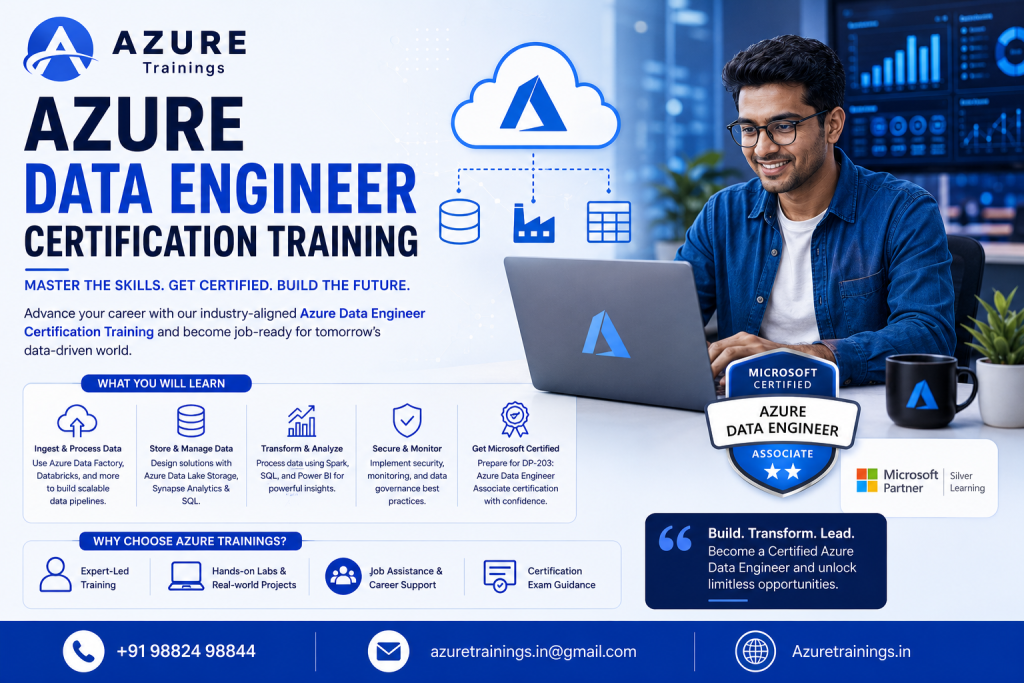
If you are exploring a career in cloud and data, Azure Data Engineer Certification Training is one of the most practical investments you can make in 2026. Demand for people who can move, clean, model and serve data on the cloud keeps rising, and Microsoft’s data stack sits at the centre of that demand for thousands of Indian employers.
So what exactly is this training? In simple terms, Azure Data Engineer Certification Training is a structured program that teaches you to design, build, secure and optimise data solutions on Microsoft Azure and Microsoft Fabric — and prepares you for Microsoft’s official certification exam. You learn the tools (Azure Data Factory, Databricks, Synapse, Fabric, SQL, Python, Spark), the patterns (ingestion, transformation, orchestration, monitoring), and the exam skills needed to earn a credential employers recognise.
Why do Azure certifications matter? A certification is a verifiable signal. It tells a hiring manager that an independent body — Microsoft — has tested your skills against a defined standard. In a crowded job market, that signal helps your résumé survive the first screening, and it often nudges your offer higher.
The career opportunities are real. Certified Azure data professionals work as data engineers, analytics engineers, ETL developers, cloud data engineers and, later, data architects. The industry demand is broad: banking and financial services, healthcare, retail, e-commerce, consulting and product companies all hire for these roles, and cloud is one of the fastest-growing skill areas in India.
One important note up front, because most articles get this wrong: the old DP-203 “Azure Data Engineer Associate” exam was retired by Microsoft on 31 March 2025. The current credential is DP-700, the Fabric Data Engineer Associate. We’ll use the correct, current path throughout this guide.
What is Azure Data Engineer Certification Training?
Azure Data Engineer Certification Training is a guided program that teaches you to build end-to-end data solutions on Azure and Microsoft Fabric, and prepares you for Microsoft’s DP-700 certification exam. It combines concept lessons, hands-on labs, real-world projects and exam practice so you can both do the job and prove the skill.
A good program covers three things together:
- Foundations — how cloud works, core data concepts, and the Azure/Fabric ecosystem.
- Engineering skills — ingesting data from many sources, transforming it with SQL, Python and Spark, orchestrating pipelines, and securing and monitoring the result.
- Certification readiness — mapping every skill to the official exam objectives, with practice assessments and mock exams.
The goal is not just to pass an exam. It is to make you employable: able to walk into a project, understand the data architecture, and contribute from week one.
Why Azure Data Engineer Certification Matters in 2026
Three forces make this certification especially valuable right now.
1. Cloud adoption in India is accelerating. India’s cloud computing market is large and growing fast — estimated in the low-to-mid tens of billions of US dollars in 2026 and projected to keep compounding at roughly 19–27% a year through the early 2030s, depending on the analyst. More cloud means more data platforms, and more data platforms mean more data engineers.
2. Microsoft Fabric reset the playing field. Microsoft retired DP-203 because it moved its data story onto Microsoft Fabric, a unified platform that combines data engineering, warehousing, real-time analytics and business intelligence. Fabric is new, so certified Fabric engineers are still relatively rare — which gives early movers with DP-700 a hiring edge while the credential is fresh.
3. The signal still works. Certifications remain one of the cleanest ways for a recruiter to filter candidates. A DP-700 on your profile says you understand the current platform, not the one that was sunset over a year ago.
Benefits of Azure Data Engineer Certification Training
- Job-ready skills. You learn the exact tools used in production data teams, not just theory.
- A recognised credential. DP-700 is a globally recognised Microsoft certification you can list (with its Credly badge) on LinkedIn and your résumé.
- Faster career growth. Validated skills help you move from entry-level to mid and senior roles with clearer salary jumps.
- Hands-on confidence. The DP-700 exam tests practical decisions — which storage to use, when to choose a dataflow versus a notebook — so trained candidates with lab experience perform better.
- Structured learning. Instead of guessing what to study, you follow a path aligned to the official exam objectives.
- Career flexibility. The same skills transfer across BFSI, healthcare, retail, consulting and product companies.
Azure Data Engineer Certification Training Course Overview
A complete program is usually structured to take a beginner to exam-ready in a few months of consistent study. A typical overview looks like this:
- Duration: commonly 3–4 months of structured learning (faster if you already know SQL or have prior cloud exposure).
- Format: online, offline (classroom) or hybrid, depending on the institute.
- Prerequisites: none formal — basic programming logic and database familiarity help.
- Outcome: readiness for the DP-700 exam, plus a portfolio of hands-on projects.
- Certification path covered: AZ-900 (fundamentals), DP-900 (data fundamentals) and DP-700 (data engineering), with DP-600 as an optional analytics add-on.
Skills You Will Learn During Azure Data Engineer Certification Training
These map to the core skills required for an Azure Data Engineer. By the end of a complete program, you should be comfortable with:
- Data ingestion — batch and streaming, from databases, files and APIs.
- Data transformation — using SQL, Python (PySpark) and, in Fabric, Power Query (M) and KQL for real-time data.
- Pipeline orchestration — building, scheduling and parameterising pipelines.
- Lakehouse and warehouse design — medallion (bronze/silver/gold) architecture, OneLake, Lakehouse and Warehouse in Fabric.
- Security and governance — workspace, item-level and row/column-level access, sensitivity labels, compliance.
- Monitoring and optimisation — tuning performance, troubleshooting slow pipelines and right-sizing capacity.
- DevOps for data — version control with Git (Azure DevOps or GitHub) and deployment pipelines.
Azure Tools Covered in Certification Training
Strong programs teach both the classic Azure data services (still widely used in existing projects) and the Fabric-native equivalents that DP-700 emphasises. Here is a closer look at the Azure Data Engineer tools you’ll work with:
- Azure Data Factory (ADF): Azure’s cloud ETL/ELT and orchestration service for building and scheduling data pipelines. In Fabric, this becomes the Fabric-native Data Factory experience.
- Azure Databricks: A managed Apache Spark platform for large-scale data processing, engineering and machine learning.
- Azure Synapse Analytics: An analytics service that unified data warehousing and big-data analytics; in the Fabric era, Lakehouse and Warehouse take over much of this role.
- Azure Data Lake Storage Gen2 (ADLS Gen2): Scalable, hierarchical cloud storage for big data. Fabric introduces OneLake as its unified storage layer.
- Microsoft Fabric: Microsoft’s unified, SaaS analytics platform — the centre of the current data-engineering story and the focus of DP-700.
- Power BI: Microsoft’s business intelligence and visualisation tool, now deeply integrated into Fabric.
- SQL: The core query language for relational data, used across warehouses, lakehouses and analytics.
- Python: The primary programming language for data engineering, used heavily through PySpark.
- Apache Spark: The distributed processing engine behind Databricks and Fabric notebooks for large-scale transformation.
- Azure DevOps: Microsoft’s suite for version control, CI/CD and project tracking — used to deploy data solutions reliably.
- GitHub: Git-based version control and collaboration, increasingly used to manage Fabric and Azure data code.
Azure Data Engineer Certification Exam Details
Here is the current, accurate picture for the data-engineering credential.
- Certification: Microsoft Certified: Fabric Data Engineer Associate
- Exam code: DP-700
- Exam title: Implementing Data Engineering Solutions Using Microsoft Fabric
- Replaces: DP-203 (retired 31 March 2025)
- Format: roughly 40–60 questions, including case studies and interactive items
- Duration: about 100 minutes
- Passing score: 700 out of 1000 (scaled scoring)
- Cost: about US$165 (local pricing and taxes vary in India — confirm on the Microsoft exam page)
- Delivery: Pearson VUE — test centre or online proctored (OnVUE)
- Renewal: free annual renewal assessment on Microsoft Learn
The exam is built around three roughly equally weighted domains (about 30–35% each):
- Implement and manage an analytics solution
- Ingest and transform data
- Monitor and optimise an analytics solution
What changed from DP-203 to DP-700: OneLake replaces ADLS Gen2 as the primary storage layer, Fabric Data Factory replaces standalone Azure Data Factory, Lakehouse and Warehouse replace Synapse pools, notebooks are Fabric-native, and KQL (Kusto Query Language) becomes important for real-time analytics. The underlying job is the same; the platform is Fabric-first.
Azure Data Engineer Certification Eligibility
There are no formal prerequisites for DP-700 — anyone can attempt it. That said, you’ll succeed faster if you have:
- Comfort with SQL for querying and transformation
- Basic Python / PySpark for data processing
- Some exposure to KQL for real-time/streaming scenarios
- Hands-on time in a Microsoft Fabric workspace (the free trial is enough to start)
Microsoft recommends DP-900 (Azure Data Fundamentals) as helpful background, though it is not required. Complete beginners can absolutely start here — they simply add a few extra weeks for foundations.
Azure Data Engineer Certification Training Syllabus
A representative, exam-aligned Azure Data Engineer syllabus looks like this:
- Cloud and Azure fundamentals — core cloud concepts, Azure services, security and pricing (AZ-900 territory).
- Data fundamentals — relational vs non-relational data, analytics workloads (DP-900 territory).
- Microsoft Fabric foundations — OneLake, Lakehouse, Warehouse, workspaces and capacities.
- Data ingestion — pipelines, Dataflow Gen2, batch and streaming sources, Eventstreams.
- Data transformation — SQL, PySpark in notebooks, Power Query (M), the medallion architecture.
- Real-time intelligence — KQL databases, Eventhouse, windowing functions.
- Security and governance — access control, masking, sensitivity labels, data protection.
- DevOps and deployment — Git integration, deployment pipelines, CI/CD for Fabric.
- Monitoring and optimisation — performance tuning, capacity management, troubleshooting.
- Exam preparation — domain-by-domain review, practice assessments and full mock exams.
Azure Data Engineer Jobs After Certification
Certification opens the door to several role families:
- Azure Data Engineer / Cloud Data Engineer — building and running pipelines and lakehouses.
- Analytics Engineer — bridging engineering and BI (often paired with DP-600).
- ETL / Data Pipeline Developer — focused on data movement and transformation.
- Big Data Engineer — Spark- and Databricks-heavy roles.
- Senior Data Engineer → Data Architect — as you gain experience, you move toward designing the whole platform.
Employers span BFSI, healthcare, retail and e-commerce, consulting, and product companies. In 2026, postings that mention Microsoft Fabric or DP-700 are still relatively uncommon, which works in a certified candidate’s favour.
Azure Data Engineer Salary After Certification
Salaries are attractive — but it pays to be realistic rather than rely on inflated headline numbers. In Hyderabad, the average Azure Data Engineer salary is around ₹9 LPA, with a typical range of roughly ₹5.85 lakh to ₹15.75 lakh (Glassdoor, March 2026). Across India, the average sits in a similar ₹8.25–9.9 LPA band (Glassdoor and PayScale, late 2025–2026).
Experience | Job Role | Average Salary (India) | Top-End Salary |
0–2 Years | Azure Data Engineer | ₹5–7 LPA | ~₹9 LPA |
3–5 Years | Azure Data Engineer | ₹9–13 LPA | ~₹16 LPA |
6–10 Years | Senior Azure Data Engineer | ₹15–22 LPA | ~₹28 LPA |
10+ Years | Azure Data Architect | ₹24–32 LPA | ₹40 LPA+ |
Two honest caveats: salary depends far more on demonstrated skill and project experience than on the certificate alone, and very high “₹30L+ for everyone” claims you see on some sites are outliers, not averages.
Top Companies Hiring Certified Azure Data Engineers
Demand comes from a wide mix of employers, including:
- IT services and consulting: TCS, Infosys, Wipro, Accenture, Cognizant, Capgemini, LTIMindtree.
- Product and tech companies building cloud data platforms.
- BFSI (banks, insurers, fintech) for analytics, fraud detection and reporting.
- Healthcare, retail and e-commerce for data platforms and personalisation.
- GCCs (global capability centres) in Hyderabad, Bengaluru, Pune and Chennai.
Hyderabad in particular is a strong market: the southern region is attracting significant hyperscale data-centre investment, and the city is repeatedly named among India’s leading cloud and IT hubs.
Azure Data Engineer Certification Training vs Self-Learning
Both routes can work. Here’s an honest comparison.
Factor | Certification Training | Self-Learning |
Structure | Clear, exam-aligned path | You build your own (easy to miss topics) |
Hands-on labs | Guided, with feedback | Self-arranged; depends on discipline |
Time to exam-ready | Usually faster | Often longer, with detours |
Doubt resolution | Trainer/mentor support | Forums and trial-and-error |
Fabric (new platform) | Curated, current material | Many online guides still reference retired DP-203 |
Cost | Course fee | Lower out-of-pocket, higher time cost |
Best for | Beginners, career switchers, busy professionals | Experienced engineers comfortable self-directing |
Certification Roadmap
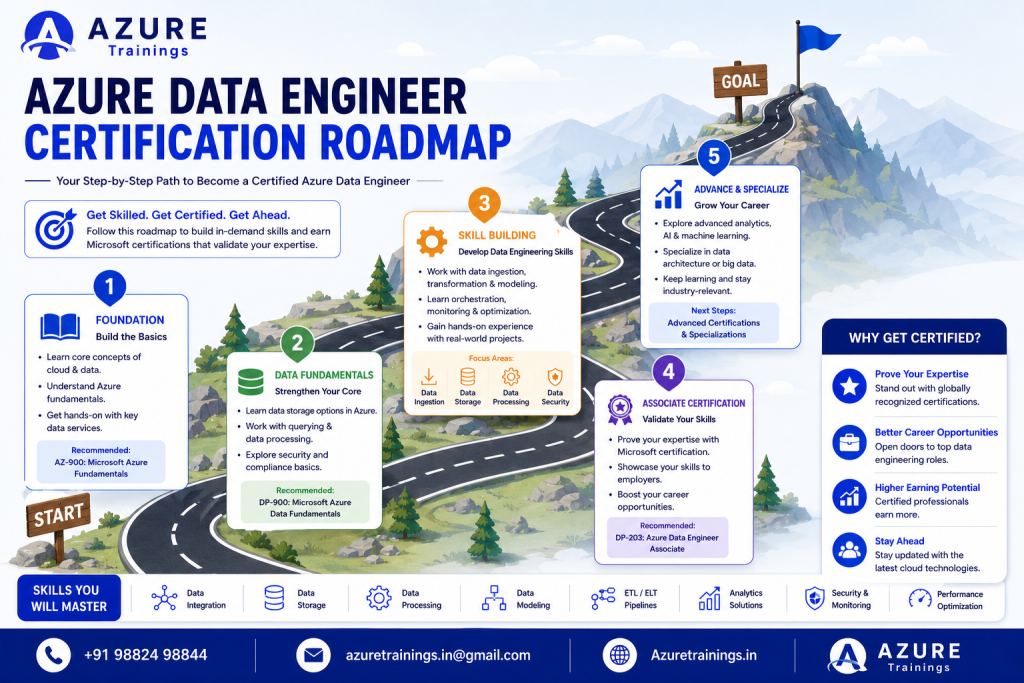
The current, correct Microsoft path for a data engineer:
Level | Focus / Skills | Certification (Exam Code) |
Beginner | Cloud fundamentals | |
Foundational | Core data concepts on Azure | |
Core — Data Engineering | Fabric pipelines, lakehouse, transformation | Fabric Data Engineer Associate (DP-700) — replaces retired DP-203 |
Advanced — Analytics | Semantic models, analytics delivery | |
Expert — Architecture | End-to-end cloud architecture | Azure Solutions Architect Expert (AZ-305) |
The practical sequence most learners follow — laid out in our Azure Data Engineer roadmap — is AZ-900 → DP-900 → DP-700, then DP-600 if they move toward analytics, and AZ-305 later as they grow into architecture.
Azure Data Engineer Certification vs Azure Administrator Certification
Factor | Data Engineer (DP-700) | Administrator (AZ-104) |
Focus | Data pipelines, lakehouses, analytics on Fabric | Managing Azure infrastructure, identities, networking |
Core skills | SQL, Python/Spark, KQL, data modelling | VMs, storage, networking, governance |
Typical role | Data Engineer, Analytics Engineer | Cloud / Azure Administrator, SysAdmin |
Best for | People who love working with data | People who love managing systems |
Azure (DP-700) vs AWS Data Engineering Certification
Factor | Microsoft DP-700 (Fabric Data Engineer) | AWS Certified Data Engineer – Associate (DEA-C01) |
Platform | Microsoft Fabric / Azure | Amazon Web Services |
Core tooling | Fabric, OneLake, Spark, KQL, Power BI | Glue, Redshift, S3, EMR, Kinesis |
Ecosystem fit | Microsoft-shop and Power BI organisations | AWS-first organisations |
Pick this if | Your target employers use Azure/Fabric/Power BI | Your target employers are AWS-native |
Many strong engineers eventually learn both clouds, but it’s wiser to go deep on one first. For Microsoft-shop employers — common across India’s enterprise and BFSI sectors — DP-700 is the natural choice.
Industry Statistics & Trends
- Cloud adoption in India is rising sharply; the market is in the tens of billions of US dollars in 2026 and projected to keep compounding at roughly 19–27% a year into the early 2030s.
- Azure market demand remains strong: Microsoft Azure is the world’s #2 cloud platform behind AWS, with consistent double-digit year-over-year growth in its cloud business.
- Data engineering demand is broad and durable — every organisation migrating to the cloud needs people to move and model its data.
- Certification hiring trends favour current credentials: postings referencing Microsoft Fabric or DP-700 are still relatively scarce, giving certified candidates an edge.
- AI and analytics growth is multiplying the value of clean, well-engineered data — making data engineers central to AI initiatives, not peripheral.
Why Azure Data Engineer Certification Training is One of the Best IT Investments in India
- High salary potential. Even mid-level certified engineers comfortably reach the low double-digit lakhs, with senior and architect roles going substantially higher.
- Global recognition. A Microsoft certification is recognised worldwide, not just in India.
- Faster career growth. Validated, current skills shorten the climb from entry-level to senior roles.
- Cloud industry demand. Cloud is among India’s fastest-growing technology areas, and data engineering sits at its core.
- International opportunities. The same Microsoft skills are in demand across global markets, opening doors abroad and in remote roles.
For the time and money involved, few IT skill paths offer this combination of demand, salary and recognition.
Azure Data Engineer Career Path After Certification
A common progression looks like this:
- Junior / Associate Data Engineer (0–2 years) — building pipelines under guidance.
- Data Engineer (2–5 years) — owning pipelines and data models.
- Senior Data Engineer (5–8 years) — designing solutions, mentoring, optimising.
- Lead / Data Architect (8+ years) — owning the data platform and architecture.
Along the way, many engineers branch into analytics engineering (DP-600), machine-learning data work, or platform/architecture roles (AZ-305).
Future Scope of Azure Data Engineer Certification
The outlook is strong. Microsoft Fabric is still early in its adoption curve, AI and analytics are expanding the need for engineered data, and Indian cloud demand is projected to grow for years. As Fabric becomes mainstream, the DP-700 credential will shift from “early-mover advantage” to “expected baseline” — which is exactly why getting certified sooner rather than later is sensible.
How to Choose the Best Azure Data Engineer Certification Training Institute
Look for these signals:
- Current curriculum built around DP-700 and Microsoft Fabric — not the retired DP-203. If a syllabus still leads with DP-203 as the live exam, that’s a red flag.
- Experienced trainers with real project experience.
- Hands-on labs using a live Fabric workspace, plus real projects for your portfolio.
- Exam alignment with the official DP-700 domains and practice assessments.
- Flexible formats (online, offline, hybrid) and reasonable batch sizes.
- Honest outcomes — verifiable reviews and learner numbers rather than inflated salary promises.
- Placement and doubt-support that continues after the course.
Our Azure Data Engineer Training in Hyderabad at Azure Trainings is led by Bharat Sreeram, who brings 25+ years of cloud and AI experience, with a DP-700/Fabric-current curriculum and hands-on, project-based learning.
Key Takeaways
- DP-700 is the current exam. Microsoft retired DP-203 on 31 March 2025 and replaced it with the Fabric Data Engineer Associate (DP-700) credential. Any 2026 plan built around DP-203 is out of date.
- The path is AZ-900 → DP-900 → DP-700. Start with cloud fundamentals, add data fundamentals, then specialise in Fabric data engineering.
- Salaries are strong but realistic. In Hyderabad, the average Azure Data Engineer salary is around ₹9 LPA, with a typical range of roughly ₹5.85L–₹15.75L (Glassdoor, March 2026). Senior and architect roles go well beyond that.
- Training beats self-learning for most people because Microsoft Fabric is new, hands-on labs matter for the exam, and structured guidance shortens the path.
Hyderabad is a genuine cloud hub, with hyperscale data-centre investment and steady demand for certified data engineers.
Conclusion
Azure Data Engineer Certification Training is one of the smartest moves you can make in 2026 if you want a future-proof career in cloud and data. The demand is real, the salaries are strong, and the skills transfer across industries and borders. Just as importantly, the path is now clear: build your foundations with AZ-900 and DP-900, then specialise with DP-700, the current Fabric Data Engineer Associate certification — the credential that replaced the retired DP-203.
The engineers who get certified now, while Microsoft Fabric skills are still scarce, will be best positioned as the platform becomes the standard. If you’re ready to start, choose a program with a current, Fabric-first curriculum and plenty of hands-on practice — like our Fabric-first Azure Data Engineer training program — and take the first step toward a rewarding cloud data engineering career.
Frequently Asked Questions
1. Is DP-203 still valid in 2026?
No. Microsoft retired DP-203 on 31 March 2025. The current data-engineering credential is DP-700 (Fabric Data Engineer Associate). If you already passed DP-203 before retirement, it remains on your transcript per Microsoft’s policy, but new candidates should take DP-700.
2. Which certification should a beginner take first?
Start with AZ-900 (Azure Fundamentals), then DP-900 (Azure Data Fundamentals), then DP-700 for data engineering. This builds knowledge in the right order.
3. How long does it take to become an Azure Data Engineer?
With consistent study, most beginners reach exam-ready in about 3–4 months. Those with prior SQL or cloud experience often move faster.
4. Do I need coding experience?
Some helps, but it isn’t mandatory to start. You’ll learn SQL and Python (PySpark) during training. KQL is the newest skill for most learners.
5. What is the DP-700 exam like?
Around 40–60 questions in about 100 minutes, including case studies and interactive items, with a passing score of 700/1000. It tests practical Fabric decisions, not just memorisation.
6. What salary can I expect after certification in Hyderabad?
Entry-level roles commonly start around ₹5–7 LPA, with the city average around ₹9 LPA and experienced engineers earning considerably more (Glassdoor, March 2026). Skills and projects matter more than the certificate alone.
7. Is Azure Data Engineering a good career in India?
Yes. Cloud is one of India’s fastest-growing tech areas, demand spans many industries, and Microsoft Fabric skills are currently in short supply.
. Is training better than self-study?
For beginners and for learning the new Fabric platform, structured training is usually faster and lower-risk. Experienced Azure engineers may self-study using Microsoft Learn’s free DP-700 path.
9. Does the certification expire?
Microsoft associate certifications are valid for one year and can be renewed free of charge through an online assessment on Microsoft Learn.
10. What’s the difference between DP-700 and DP-600?
DP-700 (Fabric Data Engineer) focuses on data movement, transformation and operations. DP-600 (Fabric Analytics Engineer) focuses on semantic models and analytics delivery. Choose DP-700 if you own pipelines and engineering; add DP-600 if you move toward analytics.

Azure Trainings Editorial Team
Azure Trainings Editorial Team | 73+ articles published
We are a team of Azure and Data Engineering experts passionate about helping learners build successful cloud careers. Through in-depth guides, training resources, certification insights, and industry updates, we simplify Azure technologies and provide practical knowledge for career growth.
Share
