
🏆 #1 Azure Training Institute in Hyderabad
✅ 100% Placement Assistance
Azure Data Engineer syllabus in Hyderabad
The Azure Data Engineer course syllabus covers Python, SQL, data warehousing, ETL/ELT, Azure Data Factory, Data Lake Storage Gen2, Databricks with PySpark, Delta Lake, Synapse Analytics, Microsoft Fabric and Power BI. A structured 2026 syllabus runs about two to three months, includes hands-on projects, and prepares learners for the DP-700 Fabric Data Engineer Associate certification (the successor to the retired DP-203).
★★★★★
4.9/5 rated by 1329+ students · Google Verified
Table of Contents
Introduction
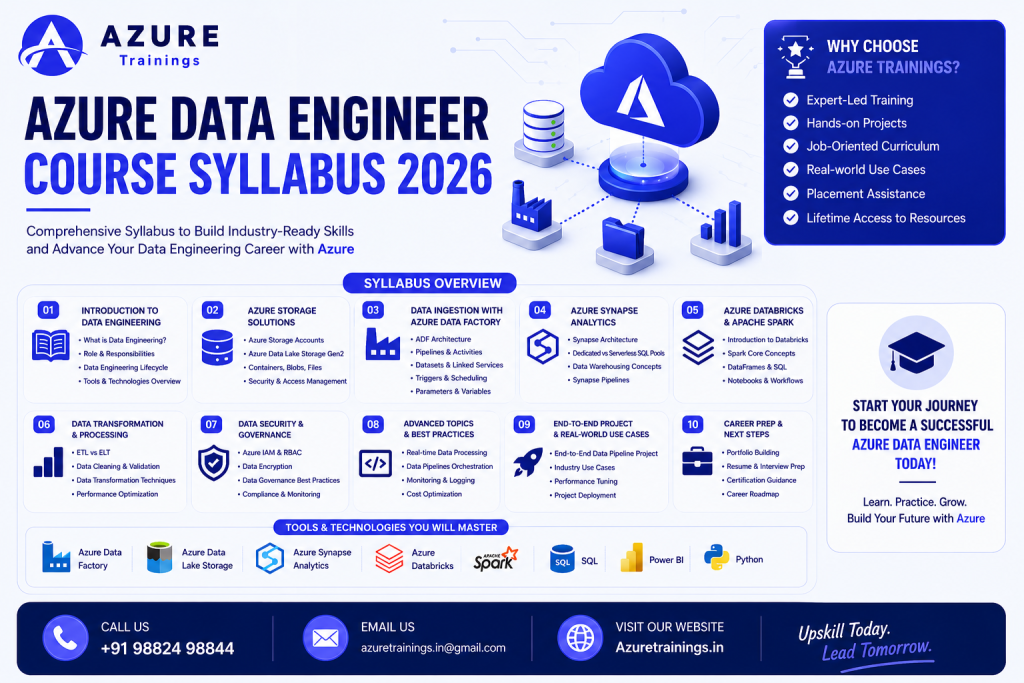
If you are planning to break into cloud data engineering, the single most useful thing you can do before paying for any program is read the Azure Data Engineer course syllabus end to end. The syllabus tells you exactly what you will learn, in what order, with which tools, and whether the program is current — and in 2026, “current” matters more than ever, because Microsoft has changed the certification path under this role.
This guide walks through a complete, up-to-date Azure Data Engineer training syllabus: every module, the tools covered, the projects you should expect, the realistic duration, and the certification you should actually target now. It is written for freshers, career switchers, and working professionals alike, and it is the detailed syllabus companion to our main Azure Data Engineer Course in Hyderabad program.
What is an Azure Data Engineer?
Azure Data Engineering is the practice of designing, building, and operating data pipelines and storage on Microsoft Azure so that raw data from many sources becomes clean, reliable, and ready for analytics and AI. An Azure Data Engineer ingests data, transforms it, stores it in lakes and warehouses, and serves it to analysts and data scientists.
In plain terms: data scientists and analysts cannot do their job until someone has moved, cleaned, and organised the data. That “someone” is the data engineer.
Why Azure Data Engineers are in high demand
Three forces are driving demand. First, Indian organisations across BFSI, healthcare, retail, e-commerce, and consulting are migrating their data platforms to the cloud. Second, every AI and analytics initiative depends on a trustworthy data pipeline underneath it — and those pipelines do not build themselves. Third, Microsoft Azure has a very large enterprise footprint in India, so Azure-specific skills are directly hireable.
Cloud data roles have been among the fastest-growing technical jobs in the country, and salary aggregators consistently place experienced Azure Data Engineers in strong pay bands (detailed figures are in the hiring-trends section below).
Azure Data Engineer Course Syllabus Overview
A complete 2026 syllabus is best understood as five layers, each building on the last:
- Foundations — Python, SQL, cloud and Azure fundamentals.
- Data concepts — data warehousing, data modelling, ETL/ELT.
- Core Azure services — Data Lake Storage Gen2, Data Factory, Databricks, Synapse.
- Modern platform — Microsoft Fabric, Delta Lake, Power BI integration, real-time/streaming.
- Production skills — governance, security, monitoring, CI/CD, and capstone projects with certification prep.
The full module-by-module table appears in section 5.
Azure Data Engineer Course Modules
The course modules translate those five layers into roughly 15–18 teaching units. Each module pairs a concept with the Azure service that implements it, so you are never learning theory in isolation. The detailed module breakdown — with tools and learning outcomes — is in the Azure Data Engineer Course Syllabus Table in section 5.
Azure Fundamentals Module
This module establishes how Azure itself works before you touch any data service. You learn the Azure portal, subscriptions and resource groups, regions and availability, storage account types, basic networking, identity (Microsoft Entra ID), and cost management.
Why it matters: Every later module deploys resources inside Azure. Without these fundamentals, learners waste time fighting the platform instead of learning data engineering. This module also maps to the AZ-900 and DP-900 fundamentals content.
Cloud Computing Concepts
Here you cover the model-level ideas behind everything else: IaaS vs PaaS vs SaaS, the shared-responsibility model, elasticity and scaling, high availability and disaster recovery, and the economics of pay-as-you-go cloud.
Why it matters: Data engineering decisions (which storage tier, which compute size, batch vs streaming) are constantly trade-offs between cost, speed, and reliability. You cannot make those trade-offs well without understanding cloud fundamentals.
SQL for Data Engineering
SQL is the non-negotiable core skill. This module goes well beyond SELECT: joins, aggregations, window functions, common table expressions, stored procedures, indexing basics, and query performance tuning, with a focus on T-SQL as used in Synapse and Fabric warehouses.
Why it matters: Most pipelines start and end with SQL. Interviews test it heavily, and warehouse modelling is impossible without it.
Python Programming for Azure Data Engineers
You learn Python at the level a data engineer actually needs: data types and control flow, functions, file and API handling, working with JSON, and the pandas library — then progressing toward PySpark.
Why it matters: Python is the glue language of data engineering and the gateway to Spark. You do not need to be a software developer, but you must be comfortable writing clean, debuggable scripts. If you want to build this base first, our Python course in Hyderabad covers it from scratch.
Data Warehousing Fundamentals
This module covers OLTP vs OLAP, the purpose of a data warehouse, dimensional modelling, star and snowflake schemas, fact and dimension tables, slowly changing dimensions, and the modern lakehouse pattern.
Why it matters: A warehouse is where analytics actually happens. If you model it badly, every downstream report and dashboard suffers — and no amount of pipeline engineering fixes a broken data model.
ETL and ELT Concepts
ETL (Extract, Transform, Load) and ELT (Extract, Load, Transform) are the two dominant pipeline patterns. This module teaches both, when to use each, idempotency, incremental loads, change data capture, and error handling.
Why it matters: Modern cloud platforms favour ELT (load raw, then transform in-platform), but you will meet both patterns in real jobs. Understanding the difference is a frequent interview filter.
Azure Data Factory Training Module
Azure Data Factory (ADF) is Azure’s primary cloud data-integration service. You learn pipelines, activities, linked services and datasets, the Copy activity, Mapping Data Flows, triggers and scheduling, integration runtimes, and parameterised, reusable pipelines.
Why it matters: ADF is one of the most widely used tools in Azure data engineering job descriptions in India. It is the orchestration backbone of countless production data platforms, so fluency here is directly hireable. Explore the dedicated Azure Data Factory training for a deeper hands-on track.
Azure Data Lake Storage Gen2 Module
Azure Data Lake Storage Gen2 (ADLS Gen2) is the scalable, cost-effective storage layer for big data. The module covers the hierarchical namespace, containers and folders, access tiers, security and access control (RBAC and ACLs), and the medallion (bronze/silver/gold) folder pattern.
Why it matters: Almost every Azure pipeline reads from or writes to ADLS Gen2. It is the foundation that Databricks, Synapse, and Fabric all build on top of. To test yourself, work through these Azure Data Lake interview questions.
Azure Databricks and PySpark Module
Azure Databricks is the managed Apache Spark platform on Azure. You learn the workspace and cluster model, notebooks, PySpark DataFrames and transformations, reading and writing to the data lake, performance optimisation, and job scheduling.
Why it matters: Databricks is the heavyweight tool for large-scale transformation. PySpark fluency separates entry-level candidates from genuinely employable engineers, because most serious data volumes are processed here.
Apache Spark for Big Data Processing
This module goes under the hood of Spark itself: distributed computing, the driver/executor architecture, lazy evaluation, partitioning, shuffles, caching, and how to read a Spark execution plan to fix slow jobs.
Why it matters: Knowing how Spark runs — not just the API — is what lets you debug and optimise real workloads instead of just running notebooks that happen to work on small data.
Delta Lake Concepts
Delta Lake adds reliability to the data lake. You learn ACID transactions on files, the transaction log, schema enforcement and evolution, time travel, MERGE/upsert operations, and the lakehouse architecture that Delta enables.
Why it matters: Plain files in a lake have no transactions or consistency guarantees. Delta Lake is what makes a “lakehouse” trustworthy enough to replace a traditional warehouse, and it underpins both Databricks and Microsoft Fabric.
Azure Synapse Analytics Module
Azure Synapse Analytics is an integrated analytics service. The module covers dedicated and serverless SQL pools, Spark pools, Synapse pipelines, and integration with the data lake and Power BI.
Why it matters: Many enterprises run their analytics on Synapse today, so it remains a core, hireable skill. Note that while Microsoft is investing heavily in Fabric, it has stated it has no current plans to retire Synapse — so learning both is the pragmatic 2026 choice.
Microsoft Fabric Training Module
Microsoft Fabric is Microsoft’s unified, SaaS analytics platform that brings data engineering, data warehousing, data science, real-time intelligence, and BI together on a single foundation called OneLake. This module covers OneLake, Lakehouse and Warehouse items, Fabric Pipelines and Dataflows Gen2, Notebooks, Eventstream/Real-Time Intelligence, and Direct Lake mode for Power BI.
Why it matters: Fabric is the direction of travel for the entire Microsoft data ecosystem and is the basis of the current data-engineering certification (DP-700). A syllabus that ignores Fabric in 2026 is teaching you yesterday’s platform.
Power BI Integration Module
Power BI is Microsoft’s business-intelligence and visualisation tool. As a data engineer you do not need to be a full BI developer, but you must understand datasets and semantic models, connecting Power BI to Synapse and Fabric (including Direct Lake), and basic report building.
Why it matters: The data you engineer is ultimately consumed in dashboards. Understanding the consumption layer makes you a better engineer and a more collaborative teammate.
Data Modeling Concepts
This module covers conceptual, logical, and physical data models; normalisation vs denormalisation; dimensional modelling; and choosing the right model for analytics workloads.
Why it matters: Data modelling is the highest-leverage skill in the syllabus. Good engineers with strong modelling instincts design systems that stay fast and maintainable as data grows.
Real-Time Projects Included in Azure Data Engineer Course
A credible program ends with end-to-end projects, not just exercises. Typical projects in a strong syllabus include:
- A batch ETL/ELT pipeline ingesting source data into ADLS Gen2, transforming it in Databricks/Spark, and loading a Synapse or Fabric warehouse.
- A medallion-architecture lakehouse using Delta Lake (bronze → silver → gold) with incremental loads.
- A real-time streaming pipeline using Event Hubs / Fabric Eventstream into a queryable store.
- An end-to-end Fabric project from OneLake ingestion to a Direct Lake Power BI report.
- A capstone integrating ingestion, transformation, modelling, serving, and basic monitoring.
Why it matters: Projects are what you put on your resume and discuss in interviews. They are the difference between “I watched a course” and “I have built this.”
Azure Data Engineer Certification Preparation
This is the section most outdated blogs get wrong, so read carefully.
- DP-203 (Azure Data Engineer Associate) was retired on 31 March 2025. New candidates can no longer earn it. If an institute is still selling “DP-203 certification training” as the current goal, treat that as a red flag for stale content.
- DP-700 — Microsoft Certified: Fabric Data Engineer Associate is the current data-engineering certification. It validates ingesting, transforming, orchestrating, monitoring, and optimising data solutions in Microsoft Fabric (lakehouses, warehouses, pipelines, notebooks, eventstreams). The exam fee is around USD 165 (varies by region).
- DP-900 — Azure Data Fundamentals is the recommended foundational certification for beginners.
- DP-600 — Fabric Analytics Engineer Associate is a complementary credential focused on semantic models and analytics delivery.
A 2026 syllabus should prepare you for DP-900 then DP-700, while still teaching the classic Azure stack (ADF, Synapse, Databricks) because that is what most current jobs use day to day.
Azure Data Engineer Course Duration and Learning Path
A realistic full syllabus takes about two to three months of consistent, instructor-led effort (weekday classes plus equal hands-on practice). You can see how this maps to a real schedule on our Azure Data Engineer training in Hyderabad page. A typical path:
- Weeks 1–3: Foundations — Python, SQL, cloud and Azure fundamentals.
- Weeks 3–6: Data warehousing, data modelling, ETL/ELT.
- Weeks 6–10: Core Azure services — ADLS Gen2, ADF, Databricks/Spark, Delta Lake, Synapse.
- Weeks 10–12: Microsoft Fabric, Power BI integration, governance, projects, and certification prep.
Experienced professionals with prior SQL/Python can move faster and focus mainly on the Azure services and certification preparation.
Azure Data Engineer Course Syllabus for Beginners
Beginners should not start with Spark. The correct beginner sequence is: cloud and Azure fundamentals → SQL → Python → data warehousing concepts → ETL/ELT → then the Azure services. Beginners benefit most from extra time on SQL and Python, because every later module assumes them.
Why it matters: The most common reason beginners stall is jumping into Databricks before they are fluent in SQL and Python. A beginner-friendly syllabus front-loads those foundations.
Complete Azure Data Engineer Course Syllabus Module Breakdown
The complete breakdown is provided as a structured table in section 5 (modules, tools covered, and learning outcomes) and as a staged roadmap in section 6 (beginner → expert). Together they give you the full curriculum at a glance, which is exactly what hiring managers and prospective learners scan for first.
Projects Included in Azure Data Engineer Training
Strong training programs build the resume for you through projects. Expect at least one batch pipeline, one lakehouse/Delta project, one real-time/streaming project, one end-to-end Microsoft Fabric project, and a capstone. Each project should produce something you can demo and explain — code in a repository, an architecture diagram, and a short write-up of the problem and your solution
Azure Data Engineer Course Syllabus for Freshers
Freshers (recent graduates with little or no industry experience) should follow the beginner sequence but add two things: heavier project work and explicit interview preparation. Because freshers compete on demonstrated ability rather than experience, the projects and a clear understanding of fundamentals (SQL, Python, warehousing, ETL) carry the most weight. Targeting DP-900 early gives freshers a verifiable credential while they build toward DP-700.
Azure Data Engineer Course Syllabus for Working Professionals
Working professionals usually need a weekend or evening track spread over about three months, with recordings for flexibility. The emphasis shifts toward depth in the core services (ADF, Databricks, Synapse, Fabric) and migrating existing skills (for example, a SQL developer or ETL developer mapping their experience onto Azure). Professionals can often skip or accelerate the absolute basics and spend more time on architecture, optimisation, and the DP-700 certification.
Skills You Will Learn from an Azure Data Engineer Course
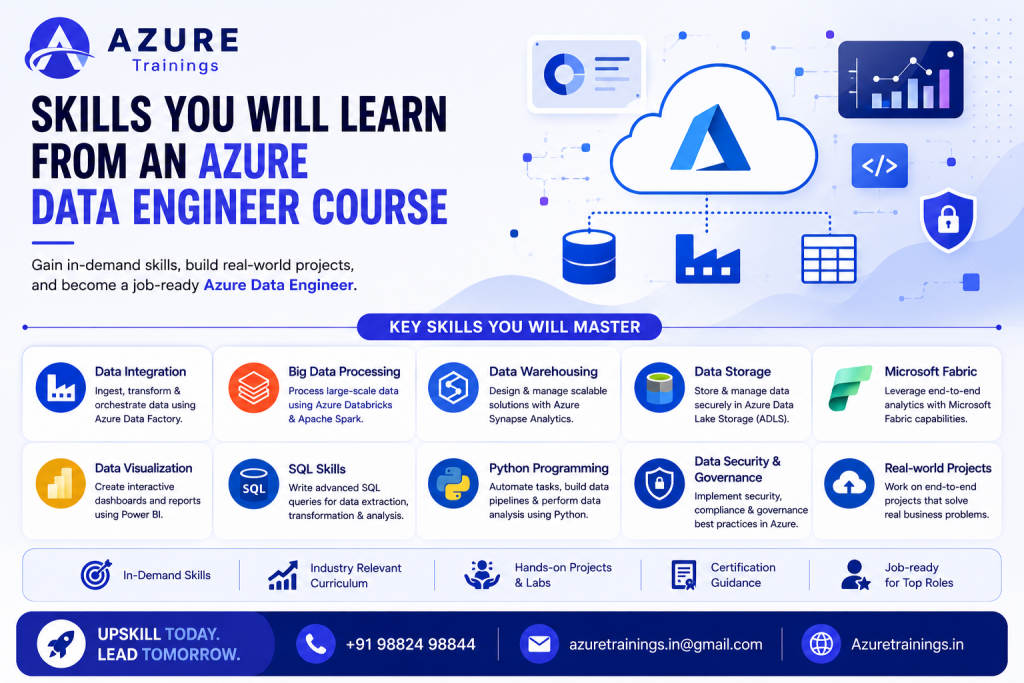
By the end of a complete program you should be able to:
- Write production-grade SQL and Python.
- Design dimensional models and lakehouse architectures.
- Build and orchestrate ETL/ELT pipelines in Azure Data Factory and Microsoft Fabric.
- Process large datasets with Apache Spark in Azure Databricks.
- Implement reliable storage with ADLS Gen2 and Delta Lake.
- Build and query warehouses in Synapse and Fabric.
- Integrate data with Power BI for analytics.
- Apply data governance, security, monitoring, and basic CI/CD.
Azure Data Engineer Certification Learning Path
The recommended 2026 path is: AZ-900 (optional cloud basics) → DP-900 (Azure Data Fundamentals) → DP-700 (Fabric Data Engineer Associate), with DP-600 as an optional complementary credential. This path replaces the older “head straight for DP-203” advice, which is no longer valid because DP-203 was retired on 31 March 2025.
Azure Data Engineer Course Syllabus Table
Module | Topic | Tools Covered | Learning Outcome |
Module 1 | Cloud & Azure Fundamentals | Azure Portal, Resource Groups, Entra ID, Storage | Navigate Azure and deploy resources confidently |
Module 2 | Cloud Computing Concepts | IaaS/PaaS/SaaS, pricing calculator | Make cost/scale/reliability trade-offs |
Module 3 | SQL for Data Engineering | T-SQL, SSMS/Azure Data Studio | Write and tune complex analytical queries |
Module 4 | Python for Data Engineering | Python, pandas | Write clean scripts and automate tasks |
Module 5 | Data Warehousing Fundamentals | Star/snowflake schema concepts | Design fact/dimension models |
Module 6 | ETL & ELT Concepts | Pipeline patterns, CDC | Choose and design the right pipeline pattern |
Module 7 | Azure Data Lake Storage Gen2 | ADLS Gen2, RBAC, ACLs | Build a secure, tiered medallion lake |
Module 8 | Azure Data Factory | ADF pipelines, Data Flows, triggers | Build and orchestrate integration pipelines |
Module 9 | Azure Databricks & PySpark | Databricks, PySpark | Transform large datasets at scale |
Module 10 | Apache Spark Internals | Spark architecture, tuning | Debug and optimise Spark jobs |
Module 11 | Delta Lake & Lakehouse | Delta Lake | Build reliable ACID lakehouse tables |
Module 12 | Azure Synapse Analytics | Synapse SQL/Spark pools | Build and query a cloud warehouse |
Module 13 | Microsoft Fabric | OneLake, Lakehouse, Warehouse, Pipelines, Notebooks | Build end-to-end solutions in Fabric |
Module 14 | Data Modeling | Dimensional/relational modelling | Model data for analytics workloads |
Module 15 | Power BI Integration | Power BI, Direct Lake | Serve engineered data to dashboards |
Module 16 | Real-Time & Streaming | Event Hubs, Stream Analytics, Fabric Eventstream | Build streaming ingestion pipelines |
Module 17 | Governance, Security & Monitoring | Purview, Key Vault, monitoring tools | Secure, govern, and monitor pipelines |
Module 18 | CI/CD, Projects & Certification Prep | Git, Azure DevOps; DP-900/DP-700 | Ship via CI/CD and pass certification |
Learning Roadmap Table
Stage | Topics Covered | Azure Services | Practical Skills | Outcome |
Beginner | Cloud basics, SQL, Python | Azure Portal, ADLS Gen2 | Querying, scripting, navigating Azure | Foundation to start building |
Intermediate | Warehousing, ETL/ELT, data modelling | Azure Data Factory, ADLS Gen2 | Building and orchestrating pipelines | Can build batch data pipelines |
Advanced | Spark, Delta Lake, Synapse | Azure Databricks, Synapse Analytics | Large-scale transformation, lakehouse design | Can build production lakehouse/warehouse |
Expert | Microsoft Fabric, real-time, governance, CI/CD | Microsoft Fabric, Event Hubs, Purview | End-to-end design, optimisation, DP-700 | Job-ready, certification-ready engineer |
Comparison Table
How the Azure Data Engineer course compares with three adjacent paths. (Salary figures are indicative India ranges from public salary aggregators as of late 2025 / early 2026 and vary widely by city, company, and experience.)
Role / Course | Skills Covered | Tools | Typical Duration | Career Opportunities | Salary Potential (India, indicative) |
Azure Data Engineer | SQL, Python, Spark, pipelines, warehousing, lakehouse | ADF, Databricks, Synapse, Fabric, ADLS Gen2, Power BI | ~2–3 months | Data Engineer, ETL Developer, Analytics Engineer, Cloud Data Engineer | Fresher ~₹4.5–8 LPA; mid ~₹12–20 LPA; senior ₹25 LPA+ |
Data Analyst | SQL, Excel, visualisation, basic stats | Power BI, Excel, SQL | ~2–4 months | Data Analyst, BI Analyst, Reporting Analyst | Fresher ~₹3–6 LPA; experienced ~₹8–15 LPA |
Data Scientist | Statistics, ML, Python/R, modelling | Python, scikit-learn, ML frameworks, notebooks | ~6–9 months | Data Scientist, ML Engineer, Applied Scientist | Fresher ~₹6–10 LPA; experienced ~₹18–35 LPA+ |
Cloud Engineer | Networking, compute, IaC, security, DevOps | Azure/AWS core, Terraform, Kubernetes | ~3–6 months | Cloud Engineer, DevOps Engineer, Cloud Administrator | Fresher ~₹4–8 LPA; experienced ~₹15–30 LPA+ |
How to read this: Data Analyst is the fastest entry but the narrowest tooling. Data Scientist is the most math-heavy and longest path. Cloud Engineer overlaps on Azure but focuses on infrastructure rather than data. Azure Data Engineer sits in the high-demand middle — broad data tooling, strong pay, and a clear certification path.
Industry Demand and Hiring Trends in India
Demand signals point in one direction. Indian enterprises across BFSI, healthcare, retail, e-commerce, consulting, and product companies are actively migrating to cloud data platforms and building modern warehouses and real-time pipelines, which keeps Azure Data Engineers among the most sought-after data roles.
On compensation, public salary aggregators (late 2025 / early 2026) put the India picture roughly as follows, though figures differ by source and should be treated as ranges, not guarantees:
- Freshers / entry level: around ₹4.5–8 LPA.
- Mid level (3–5 years): commonly ₹12–20 LPA.
- Senior (5+ years): ₹25 LPA and above in top metros.
For a Hyderabad-specific breakdown, see current Azure salaries in Hyderabad. Hiring is concentrated in Bengaluru, Hyderabad, Pune, Mumbai, Chennai, and Delhi NCR. Certification plus demonstrable projects tends to improve offers and shortlisting odds, which is precisely why the projects and certification modules belong in any serious syllabus.
Key Takeaways
- A complete Azure Data Engineer course syllabus runs five layers: foundations (Python, SQL, cloud), data concepts, core Azure services, the modern Fabric platform, and production skills with projects.
- The certification path has changed: DP-203 was retired on 31 March 2025; target DP-900 then DP-700 (Fabric Data Engineer Associate) instead.
- Learn both the classic stack (ADF, Synapse, Databricks) and Microsoft Fabric — most jobs use the former today, while Fabric is where Microsoft is heading.
- Expect two to three months for beginners; hands-on projects matter as much as the topic list for getting hired.
- Demand and pay for Azure Data Engineers in India remain strong, concentrated in metros like Hyderabad, Bengaluru, and Pune.
Conclusion
The Azure Data Engineer course syllabus is your map for turning raw cloud-data theory into a hireable skill set. The strongest 2026 curriculum builds you up in the right order — fundamentals, data concepts, core services, Microsoft Fabric, and real projects — and prepares you for the current certification path (DP-900 and DP-700), not the retired one.
If you are ready to start, choose a structured Azure Data Engineer training program that teaches both the classic Azure stack and Microsoft Fabric, includes end-to-end projects, and aligns with the DP-700 certification. Enroll in the Azure Data Engineer Course in Hyderabad at Azure Trainings and start building real cloud data engineering skills — book a free demo today.
Frequently Asked Questions
- Is the Azure Data Engineer certification (DP-203) still available? No. The DP-203 Azure Data Engineer Associate certification and its exam were retired on 31 March 2025. New candidates should target DP-700 (Microsoft Fabric Data Engineer Associate) instead, with DP-900 as the foundational certification.
- What does the Azure Data Engineer course syllabus include? A complete syllabus covers Python, SQL, cloud and Azure fundamentals, data warehousing, ETL/ELT, Azure Data Factory, Data Lake Storage Gen2, Databricks with PySpark, Apache Spark, Delta Lake, Synapse Analytics, Microsoft Fabric, Power BI integration, data modelling, governance, and real-world projects.
- How long does it take to become an Azure Data Engineer? About two to three months of consistent, instructor-led study for beginners, with weekday classes plus equal hands-on practice. Professionals who already know SQL/Python can move faster by focusing on the Azure services and certification prep.
- Is Azure Data Engineer a good career in India? Yes. Cloud data engineering is in strong demand across Indian enterprises, with healthy pay bands and clear progression into senior engineering and architecture roles. It is hands-on work, so projects matter as much as theory.
- What is the salary of an Azure Data Engineer in India? Indicative ranges from public aggregators (late 2025 / early 2026): freshers around ₹4.5–8 LPA, mid level around ₹12–20 LPA, and senior professionals ₹25 LPA and above. Actual pay varies by city, company, and skills.
- Do I need to know coding for Azure data engineering? Yes, but not as a software developer. You need solid SQL and working Python (progressing to PySpark). You do not need front-end or app-development skills.
- Can a fresher or non-IT background learner become an Azure Data Engineer? Yes. The recommended path is to master fundamentals first (cloud basics, SQL, Python), then services, then projects. Freshers should lean heavily on projects and target DP-900 early to show verifiable progress.
- What is the difference between Azure Data Factory and Azure Databricks? Azure Data Factory is primarily an orchestration and data-integration service (moving and scheduling data). Azure Databricks is a Spark-based compute platform for large-scale transformation and analytics. They are often used together: ADF orchestrates, Databricks transforms.
- Which certification should I do for Azure data engineering in 2026? Start with DP-900 (Azure Data Fundamentals), then pursue DP-700 (Fabric Data Engineer Associate). DP-600 is an optional complementary credential. Do not target DP-203 — it has been retired.
- What is the difference between a Data Engineer and a Data Analyst? A data engineer builds and maintains the pipelines, storage, and warehouses that make data usable. A data analyst uses that prepared data to produce reports and insights. Engineering is more technical and infrastructure-focused; analysis is more business- and visualisation-focused.
