
Microsoft Fabric for Data Pipelines in Azure
In today’s data-driven world, enterprises are constantly looking for faster, smarter, and more unified ways to manage data pipelines. Traditional data integration tools often require multiple services, complex integrations, and heavy maintenance. This is where Microsoft Fabric for Data Pipelines in Azure changes everything.
Microsoft Fabric is a unified analytics platform that simplifies how data is collected, transformed, stored, and consumed. When combined with the power of Azure, Microsoft Fabric for Data Pipelines in Azure becomes one of the most efficient, scalable, and future-ready solutions for modern data engineering. This blog explains what Microsoft Fabric for Data Pipelines in Azure is, how it works, its components, benefits, real-world use cases, and why every aspiring data engineer must learn it.
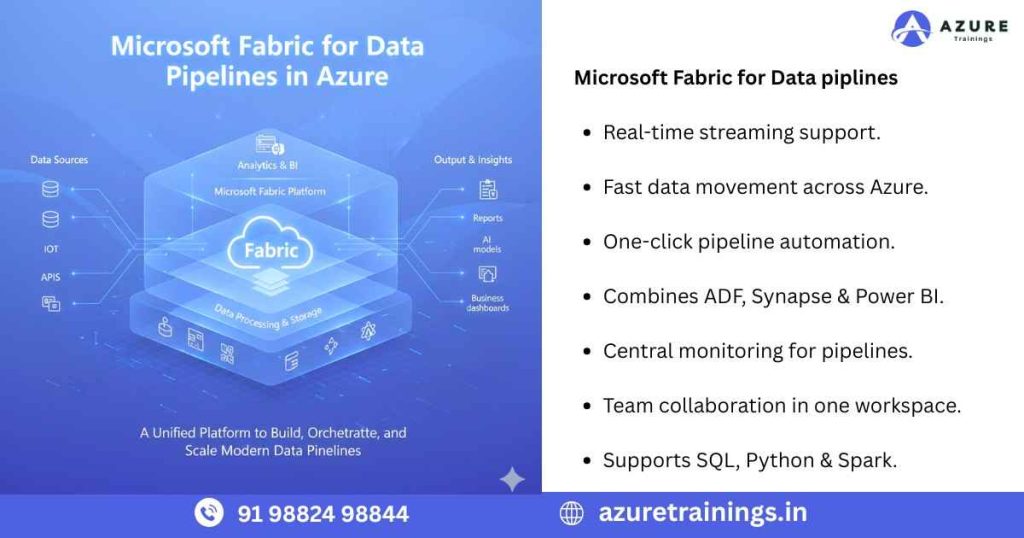
What is Microsoft Fabric for Data Pipelines in Azure?
Microsoft Fabric for Data Pipelines in Azure is an end-to-end solution that enables users to ingest, transform, orchestrate, and deliver data through a single, unified platform. It brings together multiple Azure data services into one environment, removing the need to switch between different tools and systems.
Microsoft Fabric for Data Pipelines in Azure integrates data ingestion, data transformation, storage management, real-time analytics, business intelligence, data science, machine learning, governance, and security within a single framework. Unlike traditional approaches that require complex infrastructure planning and management, Microsoft Fabric for Data Pipelines in Azure is offered as a Software as a Service platform. This means users do not need to worry about infrastructure setup, server management, performance tuning, or scaling. Everything is managed automatically, allowing teams to focus entirely on building efficient and reliable data pipelines.
Why Microsoft Fabric for Data Pipelines in Azure is Important
- In today’s digital environment, organizations generate and collect massive volumes of data from a wide variety of sources. These sources include enterprise applications, connected devices, databases, online platforms, and cloud-based services. Managing, processing, and analyzing this data efficiently has become a critical requirement for every modern business. However, many organizations still rely on fragmented tools and disconnected systems, which increases operational costs, creates data silos, and slows down decision-making
- Microsoft Fabric for Data Pipelines in Azure addresses these challenges by providing one unified and intelligent platform for end-to-end data management. Instead of using separate services for ingestion, transformation, storage, analytics, and reporting, teams can now handle the entire data lifecycle within a single environment. This unified approach reduces complexity and enables faster and more reliable data workflows.
- One of the main reasons Microsoft Fabric for Data Pipelines in Azure is important is its ability to bring all data workloads together. From raw data ingestion to advanced analytics and business intelligence, every stage is connected through a single platform. This eliminates the need to move data across different systems, reducing the chances of data loss, duplication, and inconsistencies.
- Another key benefit of Microsoft Fabric for Data Pipelines in Azure is the removal of data silos. In many traditional environments, data is stored in separate repositories that cannot easily communicate with each other. This creates obstacles for collaboration and limits the ability of teams to access the information they need. By centralizing data in a shared and governed environment, Microsoft Fabric for Data Pipelines in Azure ensures that data is accessible, consistent, and secure for all stakeholders.
- Infrastructure complexity is also significantly reduced with Microsoft Fabric for Data Pipelines in Azure. Since it is delivered as a Software as a Service platform, there is no need to manage servers, configure infrastructure, or worry about scalability. All of these responsibilities are handled automatically by the platform. This allows data engineers, analysts, and developers to focus more on building efficient data pipelines and deriving meaningful insights, rather than spending time on maintenance and configuration tasks.
Core Components of Microsoft Fabric for Data Pipelines in Azure
Microsoft Fabric for Data Pipelines in Azure is built on a powerful set of integrated components that work together to form a complete and intelligent data pipeline ecosystem. Each component is designed to simplify data operations while ensuring performance, scalability, governance, and collaboration. Instead of relying on separate services and disconnected tools, Microsoft Fabric for Data Pipelines in Azure provides a unified experience that covers the full data lifecycle from ingestion to advanced analytics.
These core components enable organizations to build, manage, and scale data pipelines in a seamless and efficient way. By bringing all essential functions into one environment, Microsoft Fabric for Data Pipelines in Azure eliminates complexity and creates a consistent foundation for data-driven decision making.
OneLake as the Unified Storage Layer
OneLake is the heart of Microsoft Fabric for Data Pipelines in Azure. It is a single, centralized, and intelligent data lake that automatically stores and manages data for all workloads within the Fabric environment. Instead of maintaining separate storage systems for different teams or projects, OneLake provides a shared, unified storage layer that is accessible across the entire platform.
This approach removes the need for managing multiple data lakes and eliminates the challenges associated with data duplication and synchronization. All data stored in OneLake can be used directly by data engineers, data scientists, and analysts without extra movement or conversion. This significantly simplifies data architecture and improves overall efficiency within Microsoft Fabric for Data Pipelines in Azure.
Data Integration and Ingestion Capabilities
Microsoft Fabric for Data Pipelines in Azure includes powerful data integration tools that make it easy to bring data from multiple sources into the platform. Whether the data comes from on-premises systems, cloud applications, databases, or streaming sources, the ingestion process is streamlined and efficient.
These built-in capabilities allow users to create reliable and repeatable data pipelines without needing complex configurations. Automated connectors, visual interface options, and flexible scheduling features help simplify the process of capturing data from different environments. This makes Microsoft Fabric for Data Pipelines in Azure suitable for both simple and complex data movement scenarios.
Data Transformation and Processing
Once data is ingested into OneLake, Microsoft Fabric for Data Pipelines in Azure provides advanced transformation and processing capabilities. These tools allow users to clean, filter, enrich, and prepare data for analysis. Data engineers can design transformation workflows that convert raw data into organized and meaningful datasets. The platform supports both code-based and low-code approaches, making it accessible to users with different skill levels. This flexibility allows teams to choose the method that best aligns with their expertise and project requirements. As a result, Microsoft Fabric for Data Pipelines in Azure promotes faster development and greater productivity.
Real Time Analytics and Streaming
Modern organizations often need insights from data as soon as it is generated. Microsoft Fabric for Data Pipelines in Azure addresses this need with built-in support for real-time analytics and streaming data processing. This makes it possible to monitor live data and respond quickly to changing conditions. By enabling real-time data pipelines, Microsoft Fabric for Data Pipelines in Azure supports use cases such as monitoring systems, detecting anomalies, and tracking performance metrics as they happen. This capability is essential for businesses that rely on immediate information to make fast and accurate decisions.
Data Ingestion in Microsoft Fabric for Data Pipelines in Azure
- Data ingestion is the foundation of every successful data pipeline. Without a reliable way to bring data into the system, it is impossible to perform meaningful analysis or generate accurate insights. Microsoft Fabric for Data Pipelines in Azure is designed to make data ingestion simple, flexible, and highly efficient for modern data-driven organizations.
- With Microsoft Fabric for Data Pipelines in Azure, users can ingest data in both batch and streaming formats. This means you can move large volumes of historical data at scheduled intervals or capture real-time data as soon as it is generated. This flexibility allows organizations to choose the ingestion approach that best suits their specific business requirements.
- Microsoft Fabric for Data Pipelines in Azure supports a wide range of data sources. Data can be brought in from cloud-based databases, on-premises systems, external applications, enterprise platforms, and data lakes. It can also ingest data from web services and event streaming platforms, making it ideal for both structured and unstructured data environments.
- By providing built-in connectors, Microsoft Fabric for Data Pipelines in Azure removes the need for complex custom coding. These connectors make it easy to establish secure and reliable connections to various data sources. As a result, data engineers and analysts can focus more on data processing and analysis instead of spending time on manual configuration.
- A major advantage of Microsoft Fabric for Data Pipelines in Azure is its visual, user-friendly interface. Similar to the experience offered by Azure Data Factory, the platform allows users to design data ingestion pipelines using a drag-and-drop approach. This makes it accessible not only to experienced data engineers but also to users with limited technical backgrounds. Even non-programmers can build, manage, and monitor data pipelines with confidence.
Data Transformation in Microsoft Fabric for Data Pipelines in Azure
Once the data is ingested, it must be cleaned, structured, and transformed. Microsoft Fabric for Data Pipelines in Azure supports transformation through integrated tools such as:
- Spark notebooks
- SQL scripts
- Dataflows
- Lakehouse transformations
This makes it possible to process large datasets, perform aggregations, apply business logic, and prepare analytics-ready data. Because Fabric is powered by Apache Spark and Delta Lake, transformations are highly scalable and efficient.
Orchestration in Microsoft Fabric for Data Pipelines in Azure
Pipeline orchestration is the process of planning, coordinating, and automating the flow of data between different systems and processes. Microsoft Fabric for Data Pipelines in Azure simplifies this complex task by providing a built-in orchestration layer that allows teams to design and manage complete data workflows in one unified environment.
With Microsoft Fabric for Data Pipelines in Azure, users can create automated pipelines that run on predefined schedules or are triggered by specific events. This ensures that data is moved and updated at the right time without requiring manual intervention. Whether the data needs to be processed daily, on demand, or in response to changes, the platform supports flexible and reliable workflow automation.
Dependency management is a major advantage of orchestration in Microsoft Fabric for Data Pipelines in Azure. Different tasks within a pipeline can be linked together so that each step runs only after the previous one has completed successfully. This helps prevent errors and ensures data accuracy throughout the entire process. If one step fails, the system can automatically stop subsequent steps or retry them based on defined rules.
Analytics and Reporting in Microsoft Fabric for Data Pipelines in Azure
Once the data is stored and transformed, it is ready for analytics. Microsoft Fabric for Data Pipelines in Azure comes with built-in integration for Power BI and real-time analytics engines.
With this integration, businesses can:
- Create interactive dashboards
- Run advanced analytics queries
- Generate reports
- Monitor real-time data changes
Everything happens on top of the same data stored in OneLake, eliminating duplication and inconsistency.
Benefits of Microsoft Fabric for Data Pipelines in Azure
There are several powerful benefits of using Microsoft Fabric for Data Pipelines in Azure.
- It provides a unified platform that combines multiple services into one.
- It removes the need for separate data lakes and data warehouses.
- It reduces the learning curve for beginners.
- It increases data processing speed.
- It ensures strong data security and governance.
- It supports both real-time and batch processing.
- It improves collaboration between data engineers, analysts, and data scientists.
- It lowers overall operational costs.
For organizations seeking efficiency, Microsoft Fabric for Data Pipelines in Azure is a game-changer.
Real-World Use Cases of Microsoft Fabric for Data Pipelines in Azure
Microsoft Fabric for Data Pipelines in Azure is already being used across many industries to simplify complex data challenges and deliver actionable insights. Its unified architecture, scalable processing, and intelligent analytics capabilities make it suitable for a wide range of business needs.
In the healthcare sector, Microsoft Fabric for Data Pipelines in Azure helps manage large volumes of sensitive medical data, including patient records, clinical reports, imaging data, and real-time monitoring information. By consolidating data into a centralized environment, healthcare providers can improve data accuracy, enhance patient care, and support faster decision-making while maintaining strong data security and compliance.
Microsoft Fabric for Data Pipelines in Azure
In today’s data-driven world, organizations are constantly looking for ways to simplify the way they collect, process, and analyze information. The emergence of Microsoft Fabric for Data Pipelines in Azure has brought a powerful shift in how data workflows are designed and managed. By combining multiple data services into a single, integrated platform, Microsoft Fabric enables businesses to build, manage, and scale data pipelines with greater ease and efficiency.
Microsoft Fabric for Data Pipelines in Azure is not just another data tool. It is a unified environment that brings together data engineering, data integration, data science, analytics, and business intelligence under one umbrella. This eliminates the need to switch between multiple platforms and helps teams work on a shared architecture, improving collaboration and operational efficiency.
Understanding the Role of Data Pipelines
Data pipelines play a crucial role in any modern data architecture. They form the backbone of data movement, ensuring that information flows from its source to its destination in a structured, reliable, and secure way. Traditionally, building and maintaining data pipelines required significant effort, technical skills, and complex configurations.
Microsoft Fabric for Data Pipelines in Azure simplifies this process by offering a unified and streamlined approach. It allows data engineers and analysts to create pipelines that extract data from various sources, transform it according to business needs, and load it into data storage or analytical systems without unnecessary complications.
With built-in tools for orchestration, monitoring, and optimization, Microsoft Fabric for Data Pipelines in Azure reduces errors and increases productivity. This makes it suitable for both beginners and experienced professionals who want to build reliable data solutions.
How Microsoft Fabric for Data Pipelines in Azure Works with Other Azure Services
Microsoft Fabric is designed to integrate deeply with the Azure ecosystem. It connects smoothly with Azure Synapse Analytics, Azure Data Lake, Azure Machine Learning, Azure SQL, Azure Event Hubs, and Azure DevOps. This strong integration allows Microsoft Fabric for Data Pipelines in Azure to act as a central hub that links all data-related services into one connected system.
Enterprises that already use Azure can easily adopt Microsoft Fabric for Data Pipelines in Azure without rebuilding their entire architecture. This compatibility makes it an ideal choice for businesses that want to modernize their data workflows while continuing to use the tools they trust. For example, data stored in Azure Data Lake can be accessed directly within Microsoft Fabric. Data transformations can be performed using built-in engineering tools, and the results can be visualized through integrated business intelligence dashboards. All of this happens in a single environment, reducing delays and improving efficiency.
Key Benefits of Microsoft Fabric for Data Pipelines in Azure
One of the biggest advantages of Microsoft Fabric for Data Pipelines in Azure is its simplicity. Instead of managing multiple tools and services separately, everything is brought together in one unified workspace. This leads to better visibility, better governance, and faster development cycles.
Another benefit is scalability. As data volumes grow, Microsoft Fabric for Data Pipelines in Azure can scale along with business needs. Whether you are dealing with small datasets or massive enterprise-level information, the platform can handle it without compromising performance. Security is also a major strength. Since it is built on the trusted Azure infrastructure, Microsoft Fabric for Data Pipelines in Azure follows strict compliance standards and security protocols. This ensures that sensitive data remains protected at every stage of the pipeline. In addition, the platform supports automation, making it easier to schedule, trigger, and manage data workflows. This reduces manual tasks and allows teams to focus on analysis and decision-making rather than routine maintenance.
Use Cases of Microsoft Fabric for Data Pipelines in Azure
Many industries can benefit from Microsoft Fabric for Data Pipelines in Azure. In finance, it can streamline the processing of transactions and generate real-time insights. In healthcare, it can manage patient data securely and help in predictive analysis. In retail, it can analyze customer behavior and improve product recommendations.
Education and technology companies can also use Microsoft Fabric for Data Pipelines in Azure to process large volumes of data and generate meaningful insights. By bringing all data activities into a single platform, it becomes easier to maintain consistency and accuracy. For data engineers, the platform provides a powerful environment to design, test, and deploy pipelines with confidence. For business users, it offers access to clean, structured, and reliable data that can support better decision-making.
Why Businesses Are Choosing Microsoft Fabric for Data Pipelines in Azure
Organizations are moving towards Microsoft Fabric for Data Pipelines in Azure because it reduces complexity while increasing performance. Instead of purchasing and managing separate tools for integration, storage, processing, and reporting, everything is handled in one solution.
This not only saves time but also reduces costs related to infrastructure and maintenance. Teams can collaborate more effectively when working on a shared platform, improving communication and reducing errors. Additionally, Microsoft continues to invest in innovation, which means Microsoft Fabric for Data Pipelines in Azure is continuously evolving with new features and improvements. This future-ready approach makes it a smart investment for businesses looking to stay ahead in the data landscape.
Learning and Adopting Microsoft Fabric for Data Pipelines in Azure
Learning Microsoft Fabric for Data Pipelines in Azure is easier than many traditional data platforms. The user-friendly interface, clear workflows, and strong documentation make it accessible for beginners while still offering advanced functionality for experienced professionals.
Anyone interested in data engineering, data analytics, or cloud computing can benefit from mastering Microsoft Fabric for Data Pipelines in Azure. It opens up new career opportunities and helps professionals stay competitive in the growing data market. With practice and real-world projects, learners can quickly build confidence and develop hands-on experience. This makes Microsoft Fabric for Data Pipelines in Azure a valuable skill for anyone aiming to build a career in the Azure ecosystem.
Future of Data Pipelines with Microsoft Fabric in Azure
The future of data management lies in unified platforms that combine simplicity, power, and scalability. Microsoft Fabric for Data Pipelines in Azure represents this future by offering an all-in-one solution for modern data challenges.
As businesses generate more data every day, the need for efficient and intelligent pipelines becomes more critical. Microsoft Fabric for Data Pipelines in Azure is well-positioned to meet this demand by providing a strong foundation for data integration, processing, analysis, and visualization. By adopting Microsoft Fabric for Data Pipelines in Azure, organizations are not only solving today’s problems but also preparing for tomorrow’s opportunities. It is a strategic move that supports innovation, growth, and smarter decision-making.
Why Data Engineers Should Learn Microsoft Fabric for Data Pipelines in Azure
For anyone planning a career in data engineering, learning Microsoft Fabric for Data Pipelines in Azure is a powerful advantage.
Most organizations are moving toward unified data platforms. Fabric is one of the fastest-growing tools in the data ecosystem.
By learning this platform, you gain skills in:
- Data ingestion
- Pipeline creation
- ETL and ELT processing
- Data modeling
- Analytics
- Governance
- Cloud architecture
These skills are in high demand and can lead to roles such as:
- Azure Data Engineer
- Fabric Engineer
- Analytics Engineer
- BI Developer
- Cloud Data Specialist
Mastering Microsoft Fabric for Data Pipelines in Azure can significantly boost your career prospects and salary potential.
Future of Microsoft Fabric for Data Pipelines in Azure
Microsoft is continuously improving Fabric by adding new features, connectors, and AI-powered capabilities. As more companies shift to cloud-native solutions, Microsoft Fabric for Data Pipelines in Azure will likely become the main standard for data management in Azure environments.
Upcoming improvements may include:
- Advanced AI-based pipeline automation
- Deeper Power BI integration
- More real-time analytics capabilities
- Improved multi-cloud connectivity
- Stronger governance features
The future of data engineering is clearly aligned with Microsoft Fabric for Data Pipelines in Azure.
Conclusion
Microsoft Fabric for Data Pipelines in Azure is a revolutionary solution that unifies data engineering, data science, real-time analytics, and business intelligence into a single powerful platform.
It eliminates the complexity of traditional data architectures, reduces operational effort, improves performance, and simplifies data management. Whether you are a beginner or an experienced data engineer, learning and using Microsoft Fabric for Data Pipelines in Azure will prepare you for the future of data and analytics.
With OneLake as its foundation and powerful tools for ingestion, transformation, orchestration, and analytics, this platform represents the next generation of data pipeline solutions.
FAQ's
Microsoft Fabric for Data Pipelines in Azure is a unified platform that helps create, manage, and automate data pipelines using integrated Azure tools and services.
Microsoft Fabric for Data Pipelines in Azure brings data ingestion, transformation, storage, and visualization into a single environment, reducing complexity.
Data engineers, analysts, data scientists, and organizations that use Azure can benefit from Microsoft Fabric for Data Pipelines in Azure.
Yes, Microsoft Fabric for Data Pipelines in Azure has a user-friendly interface that makes it easier for beginners to start working with data pipelines.
Microsoft Fabric for Data Pipelines in Azure combines multiple data tools in one platform, while Azure Data Factory focuses mainly on data integration.
Yes, Microsoft Fabric for Data Pipelines in Azure is designed to scale and support enterprise-level data workloads.
Microsoft Fabric for Data Pipelines in Azure can work with streaming and real-time services in the Azure ecosystem
Yes, Microsoft Fabric for Data Pipelines in Azure integrates smoothly with Azure Synapse for advanced analytics.
Basic pipelines can be created with minimal coding, but advanced use cases may require scripting knowledge.
Microsoft Fabric for Data Pipelines in Azure follows Azure security standards to keep data protected.
Yes, Microsoft Fabric for Data Pipelines in Azure reduces the need to manage separate tools and infrastructure manually.
Yes, Microsoft Fabric for Data Pipelines in Azure supports automation and scheduling of data pipelines.
Yes, it is built for cloud environments and works seamlessly within Azure.