
How should I prepare for an Azure interview?” — This is the first question most candidates have after learning Azure. Once you complete your training, the next big step is cracking the interview, but many people feel confused about what exactly to prepare. Is basic knowledge enough, or should you focus on advanced topics as well? These are completely normal doubts. Azure interview preparation is important because companies expect more than just theoretical answers; they look for a clear understanding and practical knowledge. You should be able to explain concepts confidently and handle real-time scenarios. With structured preparation and hands-on practice, your confidence increases, and your chances of success improve significantly.
Azure Interview Question Categories
Azure interview questions usually differ based on your experience level. Companies do not ask the same type of questions to freshers and experienced professionals. The depth of questions depends on how many years of hands-on experience you have.
- Basic (Fresher Level): At this level, interviewers mostly focus on fundamentals. They may ask about core Azure services, virtual machines, storage types, networking basics, and simple deployment concepts. The goal is to check your understanding of cloud basics and core Azure concepts.
- Intermediate (2–3 Years Experience): For candidates with some experience, questions become more practical and scenario-based. Interviewers may ask about resource management, networking configurations, security implementation, cost optimization, and troubleshooting real-time issues.
- Advanced (Experienced Level): At this stage, questions are more architecture and design-oriented. You may be asked to design high-availability solutions, disaster recovery strategies, multi-region deployments, and secure enterprise-level cloud environments. The focus is on decision-making and solution design skills.
Azure Basic Interview Questions
Now let me explain the common fresher-level questions in simple English, just like you would answer in an interview.
- What is Microsoft Azure?
Microsoft Azure is a cloud computing platform provided by Microsoft. It offers services such as virtual machines, storage, networking, databases, and security through the internet. Organizations use Azure to build, deploy, and manage applications without maintaining physical servers. - What are Azure Regions and Availability Zones?
Azure Regions are geographical locations where Microsoft has its data centers. Availability Zones are separate physical locations within a region designed to provide high availability. If one zone fails, the application can continue running in another zone. - What is a Virtual Machine?
A Virtual Machine (VM) is a virtual server that runs an operating system and applications like a physical computer. In Azure, VMs allow users to deploy scalable computing resources on demand. - What is Azure Storage?
Azure Storage is a cloud-based storage solution used to store data such as files, images, videos, and backups. It includes services like Blob Storage, File Storage, Queue Storage, and Table Storage. - What is Azure Resource Manager?
Azure Resource Manager (ARM) is the deployment and management service in Azure. It helps create, update, and manage resources using templates, allowing organized and controlled infrastructure management.
Azure Networking Interview Questions
Ippudu Azure networking meedha interview lo commonly adige questions ni simple ga answers tho explain chesthanu.
- What is Azure Virtual Network (VNet)?
Azure Virtual Network (VNet) is a logically isolated network in Azure where you can deploy and manage Azure resources securely. It allows communication between virtual machines, Azure services, and on-premise networks. - What is a Subnet in Azure?
A Subnet is a smaller network within a Virtual Network. It helps organize and segment resources inside a VNet for better management and security control. - What is a Network Security Group (NSG)?
Network Security Group (NSG) is used to control inbound and outbound traffic to Azure resources. It contains security rules that allow or deny traffic based on IP address, port, and protocol. - What is the difference between VPN Gateway and ExpressRoute?
VPN Gateway connects on-premise networks to Azure over the public internet using encryption. ExpressRoute provides a private, dedicated connection between on-premise infrastructure and Azure, offering higher security and reliability. - What is Azure Load Balancer?
Azure Load Balancer distributes incoming traffic across multiple virtual machines to ensure high availability and better performance of applications.
Azure Compute & Storage Interview Questions
Here are some commonly asked Azure Compute and Storage interview questions with simple answers, explained clearly as you would respond in an interview.
- What are the different types of Azure VM sizes?
Azure provides different VM sizes based on workload requirements. General-purpose VMs are suitable for balanced CPU and memory usage. Compute-optimized VMs are designed for high CPU performance. Memory-optimized VMs are used for memory-intensive applications. Storage-optimized VMs are ideal for heavy disk usage workloads. - What is Azure App Service?
Azure App Service is a fully managed platform used to build, deploy, and scale web applications and APIs. It supports multiple programming languages like .NET, Java, Python, and Node.js. It removes the need to manage underlying infrastructure. - What is the difference between Blob Storage and File Storage?
Blob Storage is used to store unstructured data such as images, videos, backups, and logs. It is ideal for large amounts of object data.
Azure File Storage provides fully managed file shares in the cloud that can be accessed using SMB or NFS protocols, similar to traditional file servers. - What are Managed Disks in Azure?
Managed Disks are Azure-managed virtual hard disks used with Virtual Machines. Azure handles storage account management, availability, and scalability automatically, making it easier to manage VM storage without manual configuration.
Azure Security Interview Questions
Here are some commonly asked Azure Security interview questions with clear and simple answers you can give during an interview.
- What is Role-Based Access Control (RBAC) in Azure?
Role-Based Access Control (RBAC) is used to manage access to Azure resources. It allows you to assign specific roles to users, groups, or services so they get only the permissions they need. This follows the principle of least privilege and improves security. - What is Azure Active Directory (Azure AD)?
Azure Active Directory (Azure AD) is Microsoft’s cloud-based identity and access management service. It helps manage user identities, authentication, and authorization. It supports features like Single Sign-On (SSO), Multi-Factor Authentication (MFA), and conditional access policies. - What is Azure Key Vault?
Azure Key Vault is a service used to securely store and manage sensitive information such as secrets, passwords, encryption keys, and certificates. It helps protect application data and prevents hardcoding sensitive values in code. - What is the Zero Trust concept?
Zero Trust is a security model that assumes no user or system is trusted by default, even inside the network. Every access request must be verified based on identity, device health, and other conditions. In Azure, this is implemented using identity-based access controls and continuous verification.
Azure DevOps Interview Questions
Here are some commonly asked Azure DevOps interview questions with simple and clear answers you can give during an interview.
- What is a CI/CD pipeline?
CI/CD stands for Continuous Integration and Continuous Deployment (or Delivery). A CI/CD pipeline automates the process of building, testing, and deploying applications. It helps developers integrate code changes frequently and deploy them to production quickly and reliably. - What is Azure DevOps?
Azure DevOps is a Microsoft service that provides tools for software development and project management. It includes services like Azure Repos (code repository), Azure Pipelines (CI/CD), Azure Boards (project tracking), and Azure Artifacts. It helps teams collaborate and automate the software development lifecycle. - What is Infrastructure as Code (IaC)?
Infrastructure as Code is the practice of managing and provisioning infrastructure using code instead of manual configuration. In Azure, tools like ARM Templates, Bicep, and Terraform are used to define and deploy infrastructure in a consistent and automated way. - What is the difference between ARM Templates and Bicep?
ARM Templates are JSON-based templates used to deploy Azure resources. They are powerful but can be complex and lengthy. Bicep is a simplified, more readable language built on top of ARM. It makes writing infrastructure code easier while still deploying resources through Azure Resource Manager.
Scenario-Based Interview Questions
Here are some common scenario-based Azure interview questions with structured answers you can explain confidently during an interview.
- How would you migrate an on-premise application to Azure?
First, I would assess the existing infrastructure, application dependencies, and workload requirements. Then I would choose the appropriate migration strategy, such as rehost (lift and shift), refactor, or re-architect. I would use tools like Azure Migrate to analyze and move virtual machines, databases, and applications. After migration, I would validate performance, security, and connectivity before moving to production. - How would you reduce Azure costs?
To reduce Azure costs, I would start by monitoring usage using Azure Cost Management. Then I would right-size virtual machines, remove unused resources, and shut down non-production workloads when not in use. I would also consider using Reserved Instances, auto-scaling, and storage tier optimization to control spending effectively. - How would you improve application performance in Azure?
First, I would identify bottlenecks using Azure Monitor and Application Insights. Then I would optimize VM sizes, enable auto-scaling, and use load balancers to distribute traffic. I would also improve database performance and use caching services like Azure Cache for Redis to enhance response time.
Azure Architect Level Questions
Here are some advanced, architect-level interview questions with structured answers you can confidently explain in an interview.
- How would you design a High Availability (HA) solution in Azure?
To design a high availability solution, I would deploy resources across multiple Availability Zones within a region to avoid a single point of failure. I would use Azure Load Balancer or Application Gateway to distribute traffic across multiple virtual machines. For databases, I would enable replication features like Azure SQL Geo-Replication. The goal is to ensure the application continues running even if one component fails. - How would you plan Disaster Recovery (DR) in Azure?
For disaster recovery planning, I would identify critical workloads and define RPO (Recovery Point Objective) and RTO (Recovery Time Objective). I would use Azure Site Recovery to replicate virtual machines to a secondary region. Backups would be configured using Azure Backup. Regular DR testing is important to ensure failover works properly during real incidents. - How would you design a Multi-Region Architecture in Azure?
In a multi-region architecture, I would deploy the application in at least two Azure regions for redundancy. Traffic would be routed using Azure Traffic Manager or Front Door based on health checks and performance. Data replication would be configured across regions to maintain consistency. This setup improves global availability, performance, and resilience against regional outages.
HR + Behavioral Interview Questions
Here are some commonly asked HR and behavioral questions in Azure interviews, along with simple and confident answers you can give.
- Why Azure?
I chose Azure because it is one of the leading cloud platforms used widely by enterprises across industries. It offers a strong ecosystem of infrastructure, security, DevOps, and AI services. I am interested in cloud technologies, and Azure provides continuous innovation and long-term career growth opportunities. - Why should we hire you?
You should hire me because I have a strong understanding of Azure fundamentals, along with hands-on practice in deploying and managing cloud resources. I am a quick learner, adaptable to new technologies, and capable of solving real-time issues. I am committed to continuous improvement and contributing effectively to the team. - Explain a real-time project you worked on.
In my project, I worked on deploying a web application in Azure. I created virtual machines, configured networking, set up load balancing, and implemented security using RBAC. I also monitored performance using Azure Monitor. The goal was to ensure high availability and smooth application performance in a cloud environment.
Tips to Crack Azure Interviews
If you really want to crack an Azure interview, preparation should not be limited to theory alone. Interviewers usually check how confidently you explain concepts and how well you understand real-time scenarios. Here are some important points to focus on:
- Hands-on Practice: Regularly work on the Azure portal, create virtual machines, configure networking, set up storage, and practice deployments. Practical experience helps you answer scenario-based questions confidently.
- Certification Impact: Azure certifications strengthen your profile and show that you have validated knowledge. While certification alone is not enough, it increases your credibility during shortlisting and interviews.
- Project Explanation Clarity: Be ready to clearly explain at least one real-time or practice project you worked on. Describe your role, the services you used, the challenges you faced, and how you solved them. A clear explanation builds strong confidence in the interviewer’s mind.
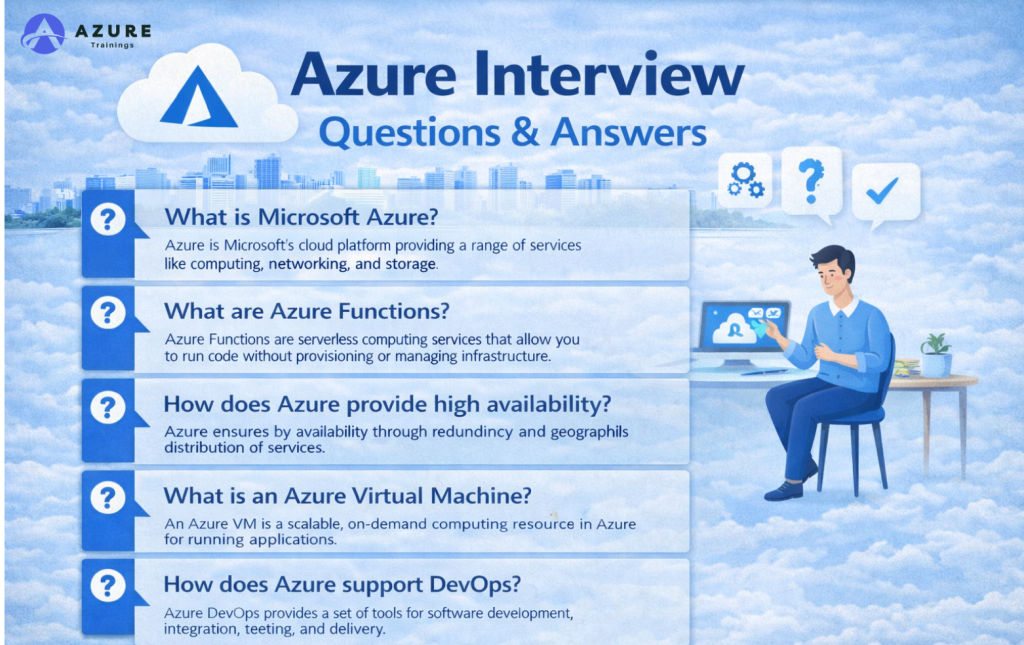
We Are Provided For Interview Questions & Answers
FAQs
The difficulty of an Azure interview depends on your preparation. If your fundamentals are clear and you have hands-on practice, you can handle both technical and scenario-based questions confidently. With proper preparation, it is manageable.
Yes, freshers do have opportunities, especially for entry-level roles like Azure Administrator or Cloud Support Engineer. Strong basic knowledge and practical exposure increase your chances of getting selected.
Certification is not mandatory, but it is highly beneficial. It strengthens your resume and improves your chances of getting shortlisted. However, practical skills and project experience are equally important.
Interviewers usually ask a mix of basic, scenario-based, and role-specific questions. They may test your understanding of core services, networking, security, DevOps, and real-time problem-solving ability.
Focus on understanding core concepts, practice regularly in the Azure portal, work on small projects, and revise common interview questions. Being able to explain your project experience clearly makes a strong impression.